notimeforporridge

Archive for the ‘Recipes’ Category

Living in the ’70s or the theory of ‘eternal recurrence’

In Recipes on March 16, 2011 at 7:47 am

Everything old is new again, recycling clothing, growing vegetables in your back yard, cooking your own food.  Along with this trend has come a nostalgia for foods we ate in our childhood.  As a kid in the ’70s I remember a friend’s mother would make up a big pot of ‘Chow Mein’ on Friday night.  The ingredients were beef mince, cabbage and a couple of packets of dried Chicken Noodle soup mix.  This was the ‘rib sticking’ food that would feed her three kids for the weekend.  It was cheap and tasted awful but, according to her mother, starving kids around the world would have been very pleased to have it!  Other favourites were French Onion dip, a mixture of cream cheese and (you guessed it) a packet of dried French Onion soup mix.  There were vol-au-vents made with chicken and a can of Cream of Mushroom soup, heated and spooned into little pastry cases.  Chocolate Ripple cake was Chocolate Ripple biscuits sandwiched together with whipped cream, then covered in cream and refrigerated.  Devils on horseback were  prunes wrapped in bacon on toothpicks.  In the ’70s anything could, in fact, be put on a toothpick – coloured cocktail onions, kabana, cheese, even tiny Swedish meatballs.  All these dishes blur the line between cooking and assembling food.

The other day I was reading some old ’70s cookbooks when it occurred to me that maybe some of the dishes are not beyond rescue.  Vol-au-vents for instance, if you give the can of soup a miss and make the mixture yourself using free range chicken, real mushrooms, a bechamel style sauce and chopped fresh herbs.  Devils on horseback could be a piece of ripe fig and a baby bocconcini, skewered, wrapped in a strip of prosciutto and warmed on a tray in the oven.  I would finish with a drizzle of balsamic vinegar.

'Devils on horseback'

Vol-au-vents

Ingredients

2 free range chicken breasts (chopped into small pieces)

250 g button mushrooms (thinly sliced)

1 brown onion (finely diced)

30 g butter

2 tbs olive oil

3 tbs chopped fresh herbs

2tbs plain flour

1/2 cup chicken stock

1/2 cup milk

1/3 cup freshly grated Parmesan cheese

8 sheets puff pastry

egg wash (1 beaten egg with a dash of milk)

Method

Heat butter and olive oil in a heavy based pan.  Add mushrooms, cook on high heat for a couple of minutes.  Reduce heat a little and add onions.  Cook for a further 2 mins.  Add diced chicken and toss around with a spoon until chicken has changed colour.  Reduce heat to low, sprinkle flour over the mixture and toss through for a minute or two until you have cooked out the ‘floury’ taste.  Add a small amount of milk, keep stirring.  Add the rest of the milk a bit at a time, stirring it through to avoid lumps.  Add chicken stock and mix through.  Cook on a low simmer for 10 mins. until sauce has thickened and chicken is cooked.  Remove from heat, add Parmesan and chopped herbs.  Season to taste.

For the cases

Cut your pastry square into quarters.  Cut each quarter into quarters again.  Place your squares on a tray lined with baking paper.  Take two more pastry sheets.  Cut in the same way.  With a small knife cut squares out of the middle of each piece of pastry leaving a a border of  about 1 cm.  Paint the edges of the squares with egg wash.  Carefully place the ‘frames’ on the pastry squares.  Repeat until you have three layers of border.  I used some of the middle bits, cut into strips, to bolster up the second layer as it becomes too wasteful for my liking.  Just make sure you have a good frame on the top layer.  Brush with egg wash and prick  the base so it doesn’t rise too much.  Cook on the top shelf  in a pre-heated 220 c oven for 15 mins. turning once.  Reduce heat to 200 c and cook for a further 10-15 mins. until lightly browned.  Cool.

To assemble

Carefully cut out the center of each square with a sharp knife.  Remove and set aside.  Fill each case with the warm mixture.  Place the little ‘hat’ you removed back on top.  Warm in 180 c oven for 10-15 mins.  Serve.
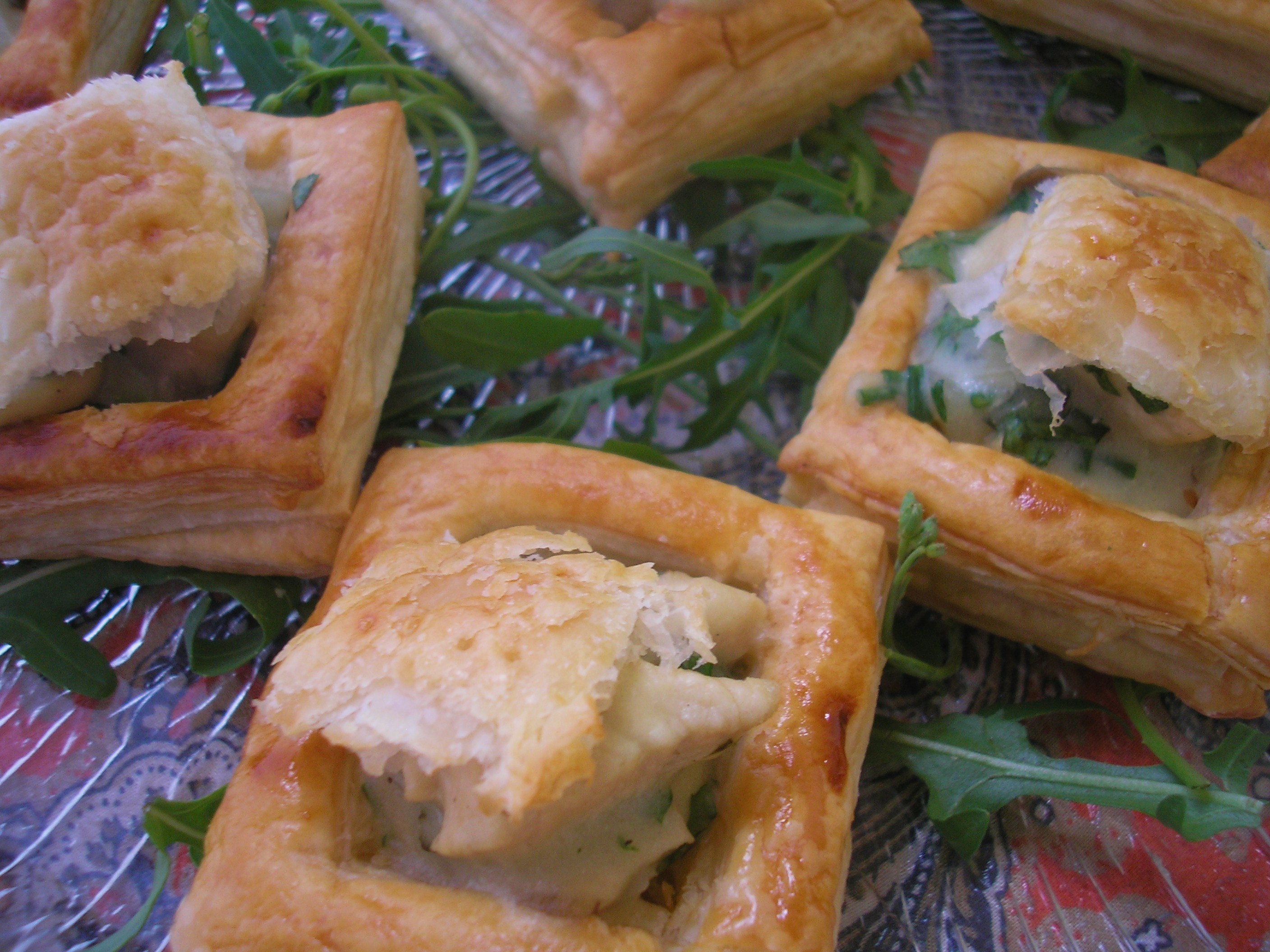
Vol-au-vents


It’s so good pho you!

In Recipes on March 8, 2011 at 5:54 am

Like dumplings soup is a much loved food throughout the world.  For peasants soup was also a way to survive.  Like most of the great foods soup was always a popular peasant dish as it is cheap and nutritious.  One of the things that makes soup so good is the fact that the meat, vegetables and aromatics are cooked in the water you are going to eat so the nutrition stays in the dish.  It doesn’t require expensive cuts of meat and it stretches the ingredients a long way.  The stock can be made from the carcass or bones and lots of vegetables and aromatics with only a little meat added the end (if desired).  Other additions that help to make soup more filling are rice, barley, pasta, noodles and the aforementioned dumplings.  Because of its goodness and the ease with which it can be eaten, soup has long been regarded as a suitable food for invalids.

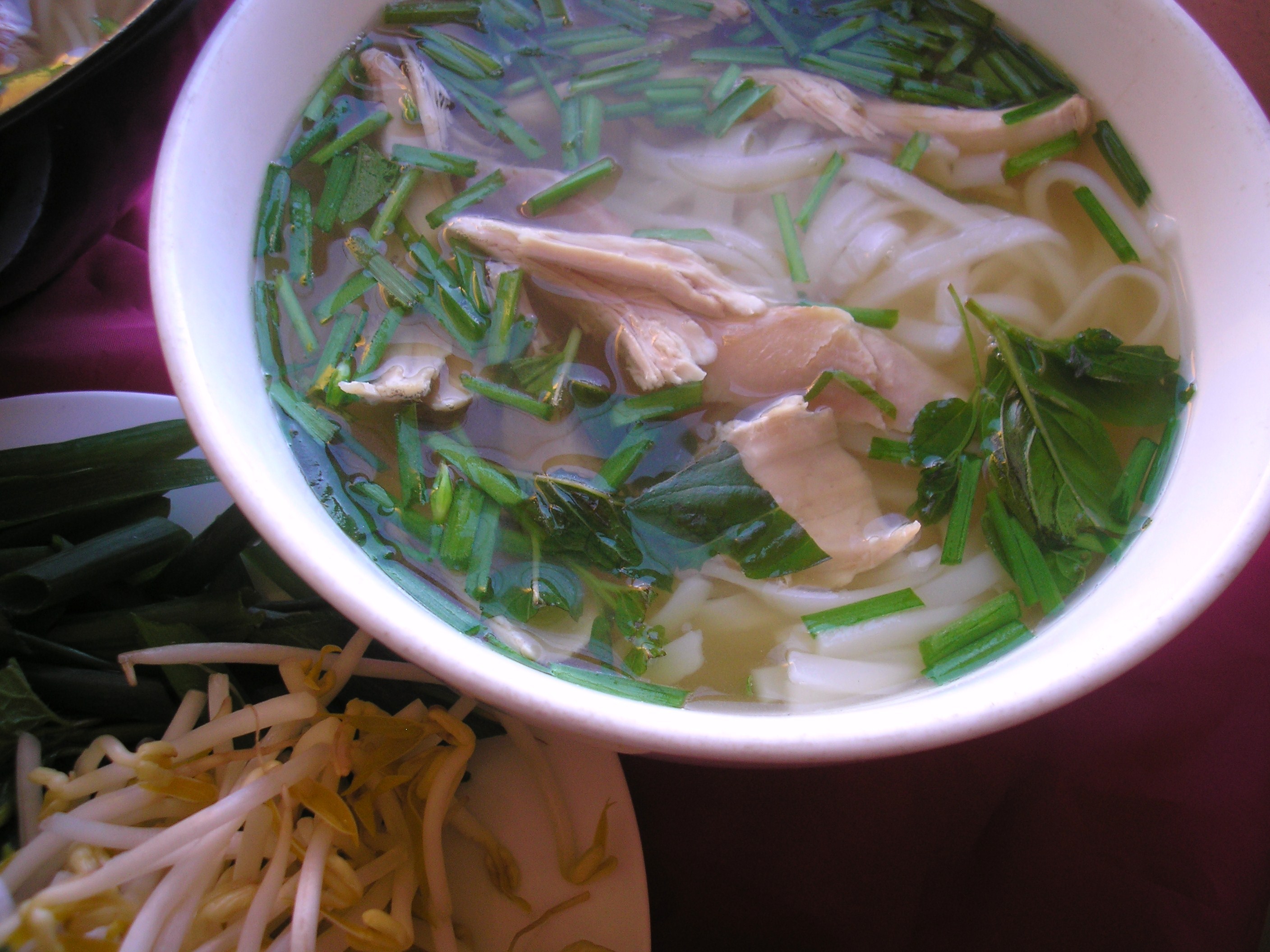
In Vietnam they often eat noodle soup or pho (pronounced ‘fer’) for breakfast.  I’m not sure about breakfast but it makes a great lunch dish in winter and I find it is almost essential when I am trying to overcome a cold.  My favourite place to eat pho in Melbourne is Hung Vuong at 128 Hopkins St., Footscray.  Just remember the small bowl is medium, the medium bowl is large and the large bowl is huge!  With the cooler weather we have been having this summer and autumn and a member of my household feeling  a bit ‘off colour’ I thought it was the perfect time to make a pot myself.  I use the recipe from Maeve O’ Meara’s Food Safari cookbook.  In the book she attributes this recipe to Angie Hong.

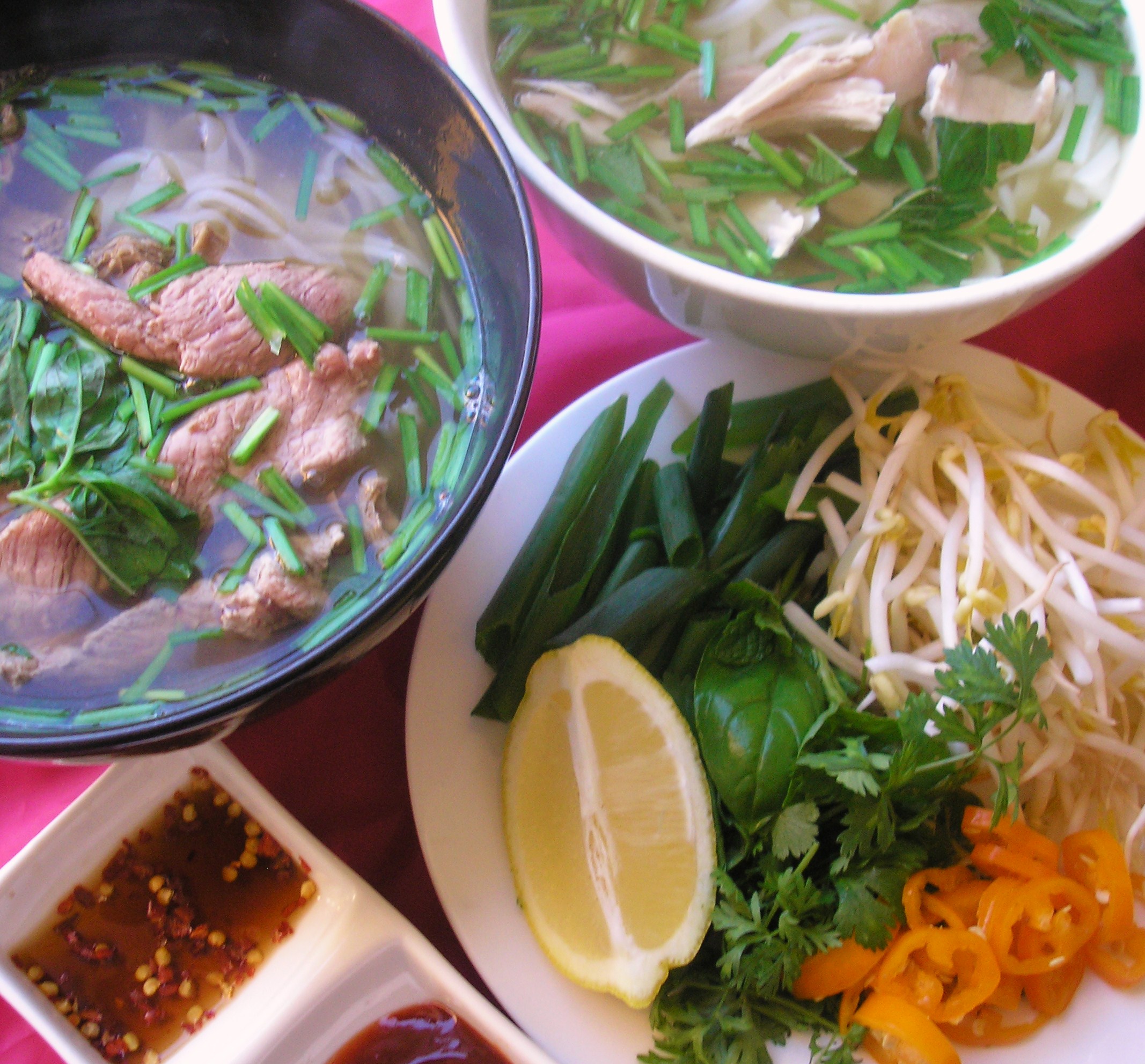
Steaming bowls of pho

Pho

Ingredients

STOCK

2 onions

10 cm piece of ginger

2 1/2 kg beef soup bones (about 1 kg will do if that’s all you can get)

5 star anise (I find this a bit too much, depending on size I would only use 2-3)

6 garlic cloves

8 cm piece cassia bark (if you don’t have this a cinnamon stick will also work)

450 g chuck steak or gravy beef

1 1/2 tbs salt (I used much less, about 1 tsp, and adjusted the seasoning at the end)

80 ml fish sauce

1 tbs palm sugar (or brown sugar if you don’t have palm sugar)

FOR SERVING BOWLS

1 large packet dried rice stick noodles or 1 kg fresh

225 g beef sirloin or fillet, finely sliced across the grain

1 onion, finely sliced

4 spring onions, green part only, finely sliced

1/2 cup chopped coriander

black pepper

TO SERVE

lime or lemon wedges

sliced chillies

Thai basil or Vietnamese mint sprigs (ordinary fresh basil and spearmint are fine too)

bean shoots

Method

Place the bones in a large pot and cover with cold water.  Bring to the boil and cook vigorously for 3 mins.  Drain off the water and rinse the bones.  Wipe out the pot, return the bones to it and add 6 litres of water.  Bring to the boil and reduce to a gentle simmer.  Add the onion, ginger and the remaining stock ingredients and cook for 1 1/2 hours.  Remove meat, cool and refrigerate.  Remove the bones, strain the stock and refrigerate.  Skim off the fat when cold.

To serve, reheat the stock, check for seasoning.  Thinly slice the cold meat.  Prepare noodles according to directions on packet.  Arrange the noodles in the bottom of deep serving bowls, top with slices of cooked meat and some of the thinly sliced raw sirloin.  Garnish with onion, spring onion and coriander.  Grind over some black pepper.  Ladle over the boiling stock.

To eat, taste the broth first, then add lime and chilli to your liking.  Add generous amounts of bean shoots, basil and mint leaves.  This recipe will serve up to 6 people.

Hint

If I want to make chicken pho I use the same method substituting a chicken carcass for the beef bones, three chicken legs for the chuck steak and a chicken breast fillet that has been gently simmered in the stock for 20 mins. and thinly sliced for the raw sirloin.

Chicken Pho

Beef Pho

Everyone has their ‘little dumpling’

In Recipes on February 28, 2011 at 4:37 am

Dumplings are a truly multicultural food.  Broadly speaking, they include the unfilled potato and bread dumplings that are added to soups and stews in Germany and Eastern Europe.  There are also the pastas of Italy gnocchi, orrichette, penne, even spaghetti if you ignore its shape.  In Asia unfilled types could include rice noodles.  Of course, that is only if you define dumplings as a sort of manufactured starch that would have been used by peasants to make food go further.  The word ‘dumpling’ would, in most people, immediately make them think of food that ‘sticks to the ribs’.  Dumplings are generally either boiled, steamed or fried.

Dumplings hit new heights when they are filled.  Think pelmeni from Russia and Siberia, ravioli, tortellini, agnolotti from Italy. There is gyoza from Japan, xio long bau and sui mai from China.  Even spring rolls fromVietnam could be seen as a type of deep fried dumpling like won tons.

When I was in Footscray the other day I dropped into Little Saigon, a wonderful Vietnamese supermarket overflowing with fresh and relatively cheap Vietnamese ingredients.  I picked up some garlic chives, three types of mint, some fresh coriander, bean shoots, birds eye chillies, lemongrass and a green papaya.  From my local butcher and Asian grocer I added some pork mince, rice vermicelli noodles, thick rice paper sheets, gyoza wrappers and limes.  From all of this I made a sort of general purpose pork mince filling suitable for dumplings or spring rolls.

Pork mince filling

Ingredients

1 kg pork mince

2 pink shallots (finely diced)

2 stalks lemongrass (finely chopped)

1 tbs coriander roots (finely chopped)

1 knob ginger (finely chopped)

2 tbs garlic chives (finely chopped)

2 tbs mint (finely chopped)

2 birds eye chillies (finely chopped)

Method

Mix all ingredients together.  Marinate in a covered bowl in the fridge for at least two hours or overnight.  When ready to use finish with some more chopped fresh garlic chives, chopped fresh herbs, a dash of fish sauce and a squeeze of lime juice.

My son and I used some of this mixture to make gyozas for our lunch.  These are actually a Japanese ‘pot sticker’ dumpling and I know the filling leans more towards Vietnamese cuisine but it didn’t really matter.  We steamed the filled skins for 15 minutes and then browned them on on one side in a frying pan.

To the mixture that was left I added a half a dozen chopped raw prawns to make a filling for Vietnamese spring rolls.

Quick and easy to wrap

Vietnamese Spring Rolls

Ingredients

12 rice paper spring roll wrappers

500 g pork and prawn mince mixture (see above)

a good handful of rice vermicelli noodles (blanched according to directions on packet)

a good handful of bean shoots

Method

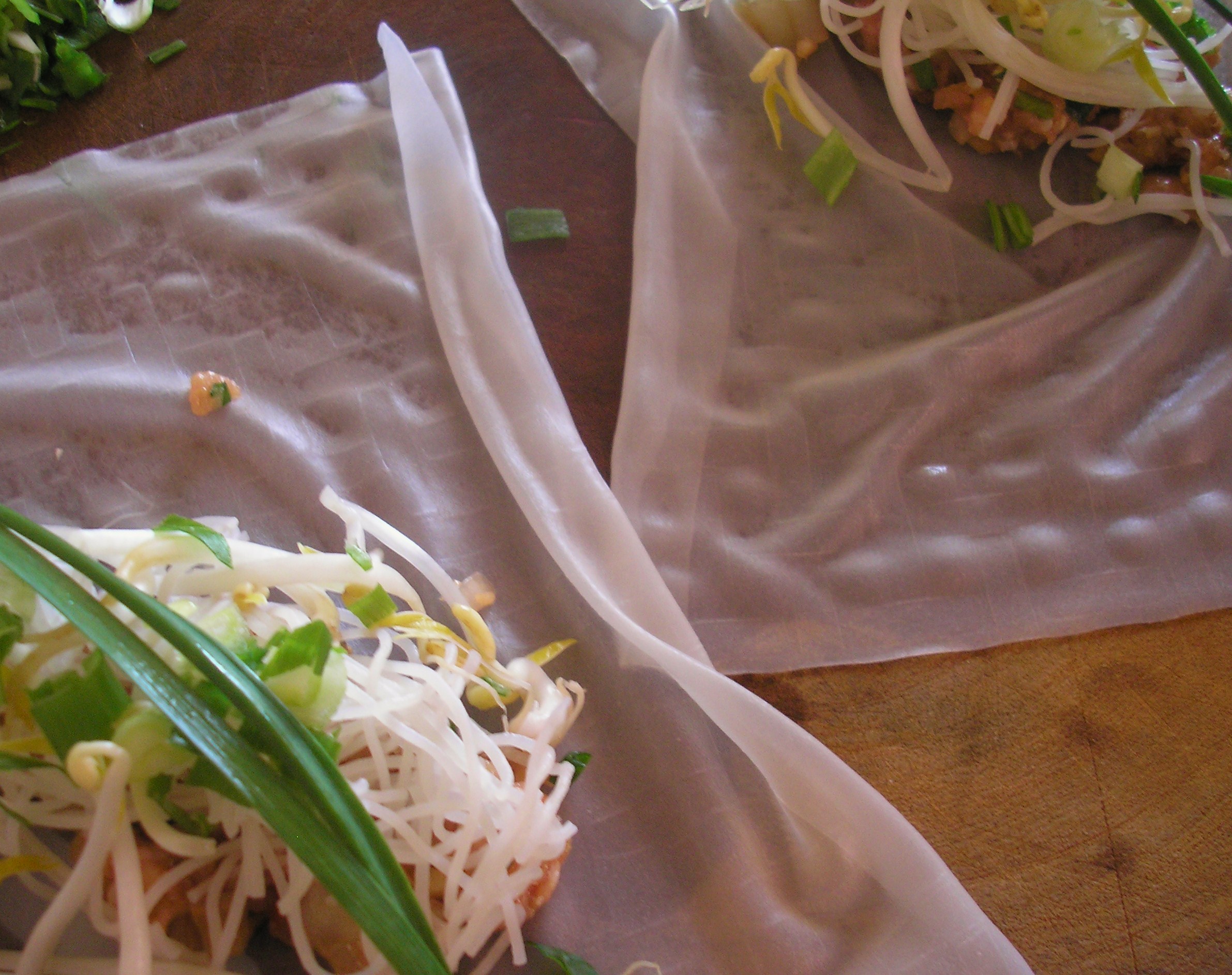
Soak the rice paper sheets in warm water a couple at a time.  This should only take about thirty seconds.  Fill with a little of the pork mixture, topped with some vermicelli noodles, bean shoots and I put a garlic chive (you could use a piece of split spring onion or a fresh mint leaf) on top to make it look pretty.  Turn over the edge nearest to you and start rolling, folding in the edges when you get half way up the sheet.  Because these ones are going to be deep fried try to make sure they are really well sealed.  If in doubt it is all right to wrap with a second sheet, just remember you will need more sheets and you may need to let the rolls rest on your board fro 20 minutes or so to dry them out a bit.  I then deep fried them in batches in hot oil.  They took about ten minutes or until they start to lightly brown (don’t expect them to go as brown as ordinary spring rolls, just make sure they are crisp).  Drain well on a rack.

Vietnamese spring rolls


Attack of the Killer Tomatoes

In Recipes on February 18, 2011 at 4:52 am

Lots of fresh basil

This 1978 spoof of 1950s B grade schlock horror films had a ridiculous plot in which killer tomato plants turned on humanity.  The plot seemed very far fetched at the time but, with the recent high prices and low quality of tomatoes in the fruit shops and supermarkets, it no longer sounds so implausible.  We all know that awful, fibrous, tasteless fruit that they sell as ‘gourmet’ tomatoes in the supermarket.  Even if you shell out a bit more for the ‘truss’ or Roma ones they are still vastly inferior to the homegrown tomatoes that I remember from my childhood.

The other day I was down at my parent’s place on the Bellarine Peninsula.  We had our usual lunch sitting in the garden looking out over their grape vines.  The food was beautiful mainly due to the freshness of the ingredients.  We had greens and kipfler potatoes that had only been picked an hour or two before we were eating them, the hard boiled eggs in the potato salad were fresh from the  chook pen and the sourdough bread that they served with runny Brie was made by my Dad using their own sourdough starter.  Nice though these ingredients were, the rich, red freshly grown tomatoes were definitely the stars of the meal.  My son, who has never been a fan of tomatoes, was urged to try some and quickly became a convert, I even saw him going back for a second helping.  Full of flavour and generously sized they were nothing like the awful tomatoes that are grown commercially.

Knowing that we are urban dwellers with limited growing space Mum and Dad are always generous with their homegrown vegetables and herbs.  This time was no exception.  I received a large quantity of tomatoes along with some fresh basil, zucchinis and cucumbers.  Mum had even potted up some of the herbs that we didn’t already have in our pot garden downstairs, for us to take home.  I didn’t want to waste anything so I made tomato sauce (Mum’s recipe) and pesto.

Look at these beauties!

Tomato Sauce

Ingredients

3 kg fresh tomatoes

5o0 g peeled and cored apples

500 g onions (peeled and chopped)

6-8 cloves garlic (peeled and chopped)

1 1/2 tsps allspice

1 tsp chilli powder

2 tbs sea salt

500 sugar

a good pinch of ground cloves and freshly grated nutmeg

600 ml cider vinegar

1 1/2 tsps curry powder

Method

Roughly chop the tomatoes and place in a large pot.  Add all the other ingredients.  Bring to the boil and simmer gently with the lid off for 3 hours.  Stir occasionally to make sure the sauce doesn’t catch on the bottom of the saucepan.  Cool.  Pass the mixture through a sieve or a mouli.  Return to the saucepan and bring to the boil.  While still hot ladle into clean, sterilized jars.  Screw the lids on tightly.

Basil Pesto

Ingredients

6 cups fresh basil leaves

100 g toasted pine nuts

3/4 cup freshly grated Parmesan cheese

4 cloves garlic (peeled)

1 cup olive oil (plus extra for packing)

Homemade tomato sauce and pesto

Method

Place all ingredients in the bowl of a food processor.  Pulse until they are smooth and well incorporated.  Spoon into sterilized jars and top with a thin layer of olive oil.  Store in the refrigerator.

You may have the “parson’s nose”

In Recipes on February 8, 2011 at 7:16 am

A relative of mine used to positively relish that fatty bit at the back of the roast chicken known as the “parson’s” or “pope’s nose”.  In our house she would be very welcome to it as no-one in my family would touch it with a barge pole.  Everyone at our place likes the breast and it is only recently that I have been able to convince people to try a leg or a bit of thigh meat.  This is frustrating as it often means quite a lot of the bird is wasted.  To stop this waste I now make stock from the left over carcass and the wings, storing it in the freezer in containers until required.

With a roast chicken I always serve plenty of baked vegetables.  These vary according to the season but one constant is potatoes.  There are various schools of thought on how to make the perfect roast potatoes.  Some cooks prefer to par boil the potatoes before roasting but I avoid this as I think it leaches out a lot of the nutrition and most of the flavour.  I find the way to get nice crispy roast potatoes is to use plenty of oil and roast on a high heat on the top shelf of the oven.

The final thing that is essential when making a roast chicken is the stuffing.  This flavours the bird from the inside so it is good to use lots of herbs and a gently fried onion along with a good grind of salt and pepper.

Roast Chicken with Basil, Parsley and Paprika

Ingredients

1 free range or organic chicken (about 1.5 kg)

butter or olive oil

1 cup fresh breadcrumbs (you may use ordinary ones if that’s all you have)

2 tbs fresh basil (finely chopped)

2 tbs fresh flat leaved parsley (finely chopped)

1 small brown onion (finely chopped and gently fried until translucent)

1 free range egg

1-2  tsp dried basil

1-2 tsp sweet paprika

freshly ground sea salt and black pepper

Method

Combine breadcrumbs, fresh basil, fresh parsley, fried onion, egg and a couple of good grinds of salt and pepper in a bowl.  Mix well.

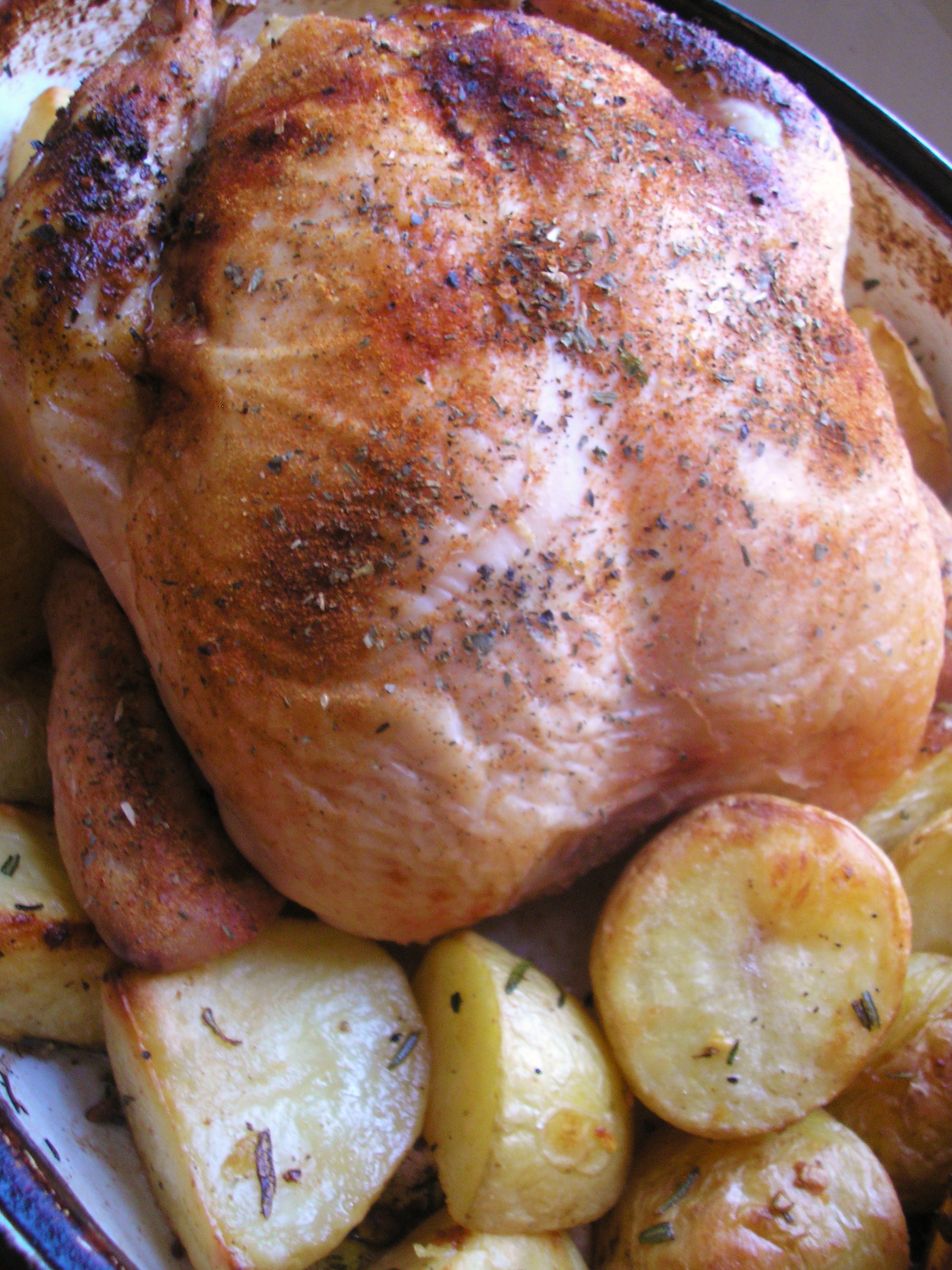
Place the chicken on a rack in a large baking dish.  Fill the cavity with the breadcrumb mixture.  Gently loosen the skin on the breast and stuff some small pieces of butter under the skin, rub the whole bird with olive oil (if you wish you can omit the butter but it does help to keep the breast moist).  Season all over with salt and pepper and sprinkle with the dried basil and paprika.  Place on the second shelf of an oven that has been heated to 200 c.  Cook for half an hour, turning once.  Cover with foil and cook for a further half hour.  Turn the chicken  and move it down to the third shelf of the oven.  Cook for a further 45 mins, removing the foil for the final 15 mins.  Remove from oven and pierce the skin between the leg and the breast.  If the juices run clear it is cooked.  Place on a plate and cover again with the foil.  Allow it to rest for at least 15 mins.  Carve and serve.

A buxom bird

Roast Potatoes with Garlic and Rosemary

Ingredients

1 kg potatoes

3-4 cloves garlic (crushed 0r finely chopped)

a few sprigs fresh rosemary (roughly chopped)

freshly ground sea salt and black pepper

plenty of oil (I like to use a combination of sunflower and olive oil as the sunflower has a higher heating point resulting in crispier potatoes)

a little butter (optional)

Method

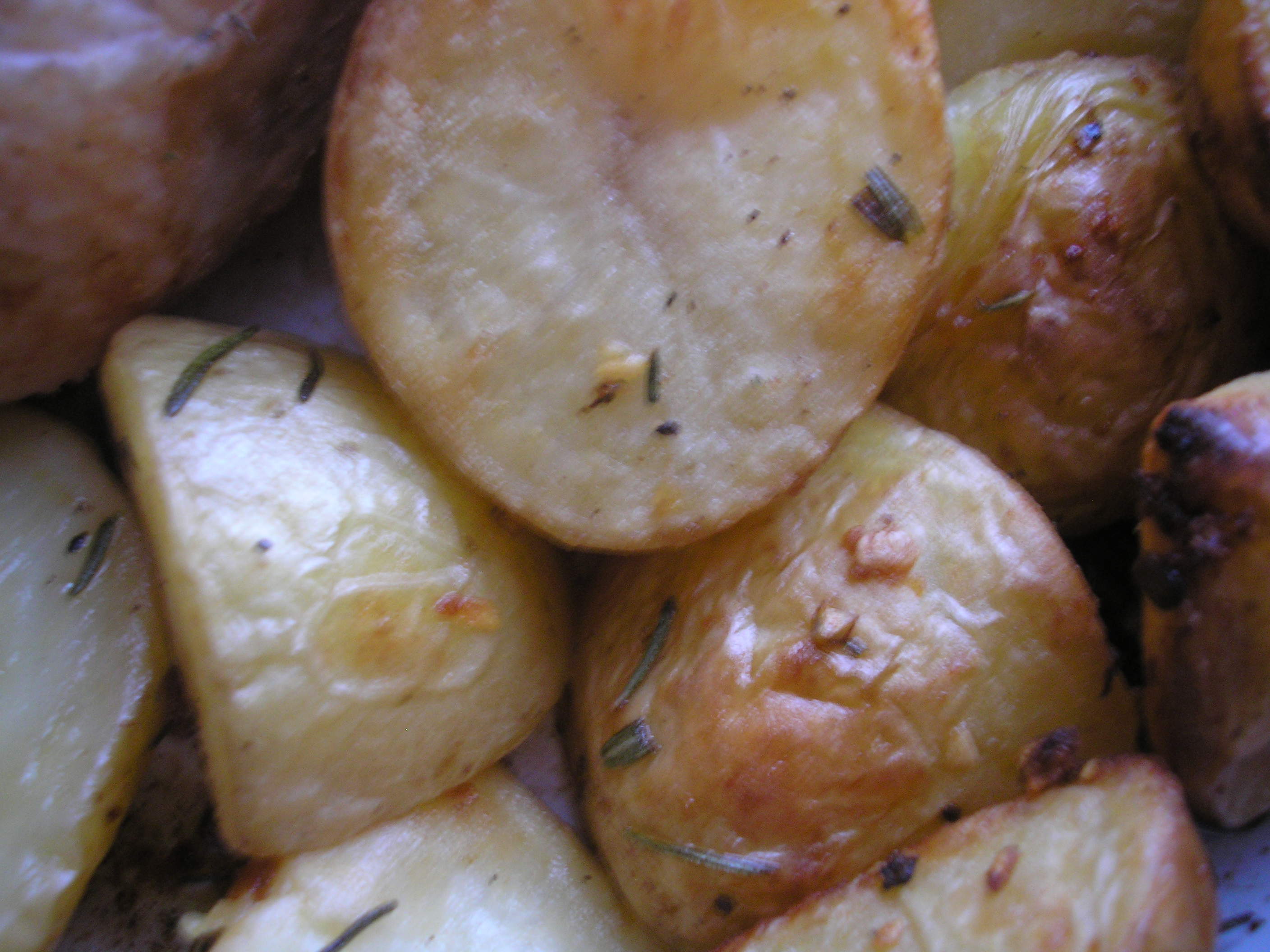
Peel the potatoes and chop them into four pieces depending on size.  Try to make sure all your pieces are of a fairly even size so that they will all cook at the same rate.  Put some oil in a baking dish.  Place the potatoes in it and move them around until they are all coated in the oil.  Season well with salt and pepper.  Sprinkle the garlic and rosemary over the potatoes.  Drizzle over a little more oil and add some small pieces of butter (if using).  Place on the top shelf of a 2oo c oven.  Cook for half an hour, shaking the pan occasionally to make sure none of the potatoes are sticking.  Remove from oven and use tongs to turn all the potatoes over.  Return to oven for a further half hour or until soft when pierced with a fork.

Roast potatoes with garlic and rosemary

Hint

Pan gravy is not difficult to make.  Remove chicken and rack from baking dish.  Drain off some of the fat, leaving some to make your roux.  Place pan on a low flame, add a small piece of butter, when melted add a tablespoon of flour.  Stir until you have cooked off the floury taste, usually about one minute.  Gradually add small amounts of chicken stock, stirring all the time.  As the gravy becomes smooth you will be able to add the stock a little faster, keep stirring until you have added 1/2-1 cup stock.  Season really well (gravy loves salt and pepper).  Add any juices from the chicken.  Allow to simmer for five minutes or until you reach your desired consistency.  Pour into a gravy boat.

Bring back the ‘Salad Days’ continued…

In Recipes on February 1, 2011 at 1:42 am

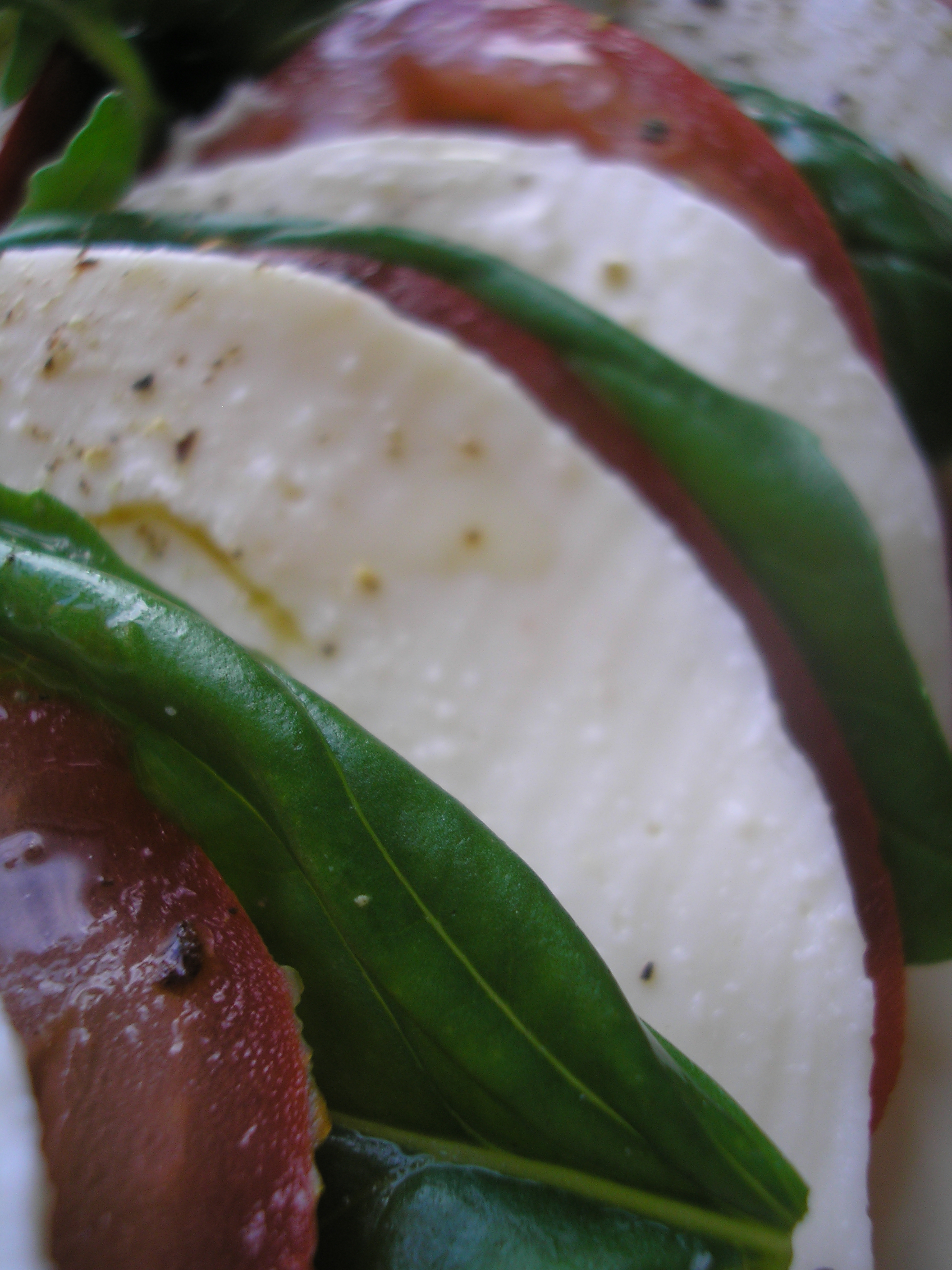
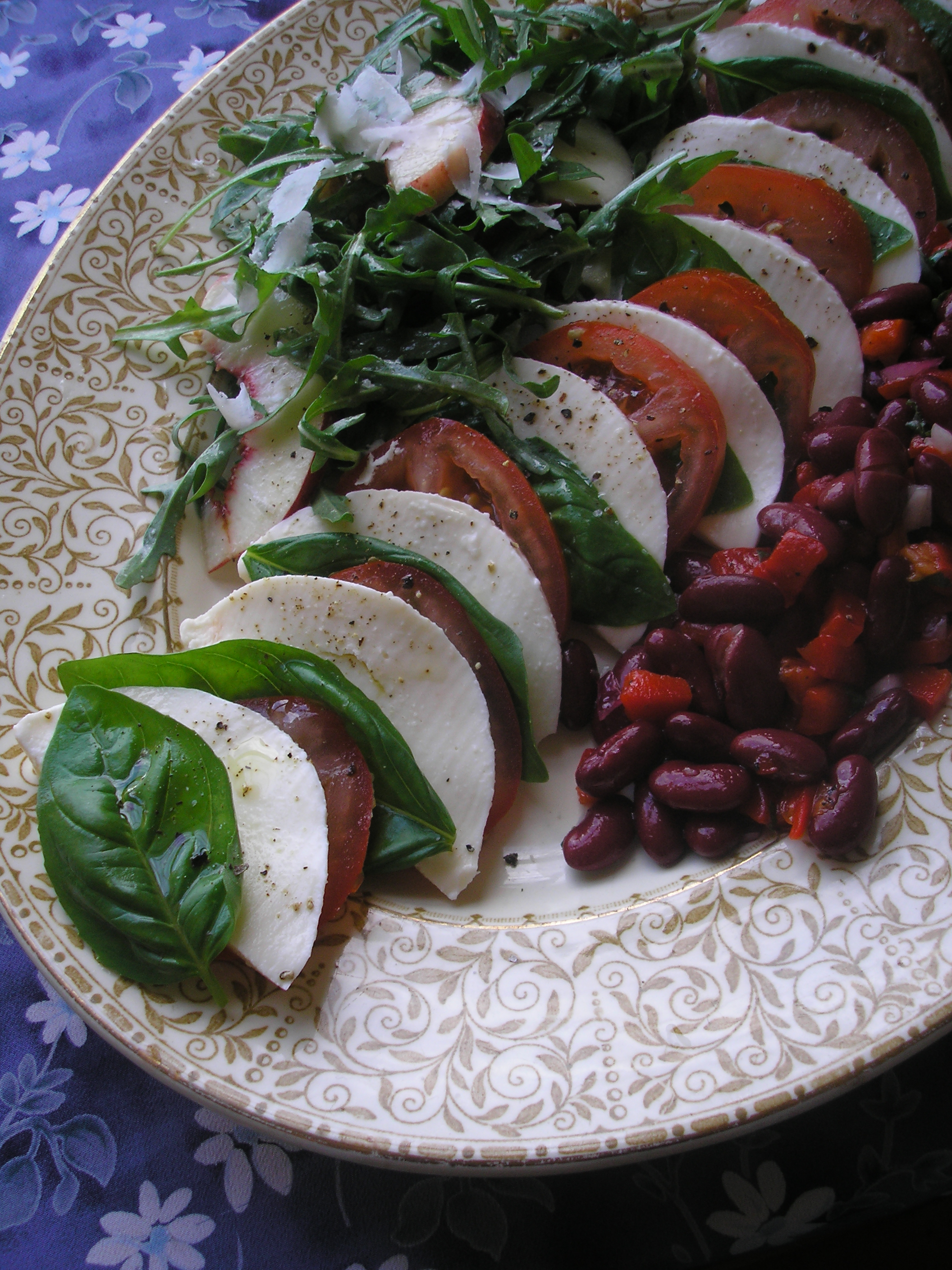
The first salad I made was the very simple Insalata Caprese.  This is just slices of the best tomatoes you can find, layered with slices of fresh mozzarella and basil leaves.  I ground a little sea salt and black pepper over it and finished with a drizzle of olive oil.  This salad is all about the freshness of the ingredients so it can only be made in summer when tomatoes and basil are at their best.

Insalata Caprese

The next salad was a version of pear, parmesan and rocket salad.  Unfortunately, the early William pears had not yet appeared in the shops so I substituted slices of white nectarine.

Nectarine, Parmesan and Rocket salad

Pear (or Nectarine), Parmesan and Rocket Salad

Ingredients

100g rocket leaves

2 large pears or 3-4 nectarines (core or stone removed and thinly sliced)

1 tbs freshly grated Parmesan cheese

a handful of walnuts

40ml olive oil

40ml white wine vinegar (or to taste)

more shaved Parmesan for the top

Method

Toss all ingredients together in a large bowl.  Top with freshly shaved Parmesan before serving.

Finally, I opened a tin of red kidney beans, added half a finely chopped Spanish onion, a few chopped basil leaves and a finely chopped roasted or char grilled red capsicum.  To dress I added the juice of a lemon and a good drizzle of olive oil, a grind of sea salt and a few grinds of black pepper.  Toss and serve.

Hint

I place a whole red capsicum on the gas jet, as each side blackens and blisters I turn until it is done all over.  I put the whole thing in a plastic bag, close it and leave it to sit for half an hour or so.  Then I remove as much of the skin as I can using tongs and scraping off any difficult bits with a knife.  This is a very easy way to char grill a capsicum if you don’t have a ridged grill.

Taste of summer

Bring back the ‘Salad Days’

In Recipes on January 31, 2011 at 5:43 am

I noticed the high prices when I was browsing in the fruit and vegetable section of my local supermarket recently.  The red capsicums and some other fruits and vegetables were expensive but no more so that they had been before the devastating Queensland floods.  Things like pineapples, melons and mangoes however, were, for a seasonal and budget conscious shopper like myself, prohibitively priced.

I was reminded of a short story by Katherine Mansfield called ‘Marriage a la Mode’.  In the story a working husband is travelling from London to visit his wife and children in the country for the weekend.  As he waits for his train he suddenly remembers that he has forgotten to buy something for the children to whom he always takes a present.  The last three times he has seen them he has taken the same boxes of sweets, hastily bought from the station’s confectionery counter.  This time he wants to take something different so he buys a melon and a pineapple from the fruit counter.  The implication is that a piece of tropical fruit was as much of a treat, in 1920s England, as a box of sweets.  Tropical fruit had to be transported to Britain from warmer climes and it wasn’t until the late 19th century that chilling methods became reliable enough to transport these fruits in any large quantity.  They were still, in the 1920s, considered exotic and as a consequence, they were also expensive.  So it is credible that they would be considered by the children, to be as big a treat as a box of sweets.

I doubt that this would happen here as our produce crisis is (hopefully) only temporary and there are still plenty of growing regions in other parts of Australia that have not been affected.  Our own children, spoilt for choice over the years with a wide variety of seasonal and relatively local fruits and vegetables, would probably choose lollies every time, no matter how much their parents would prefer them to choose the fresh produce.

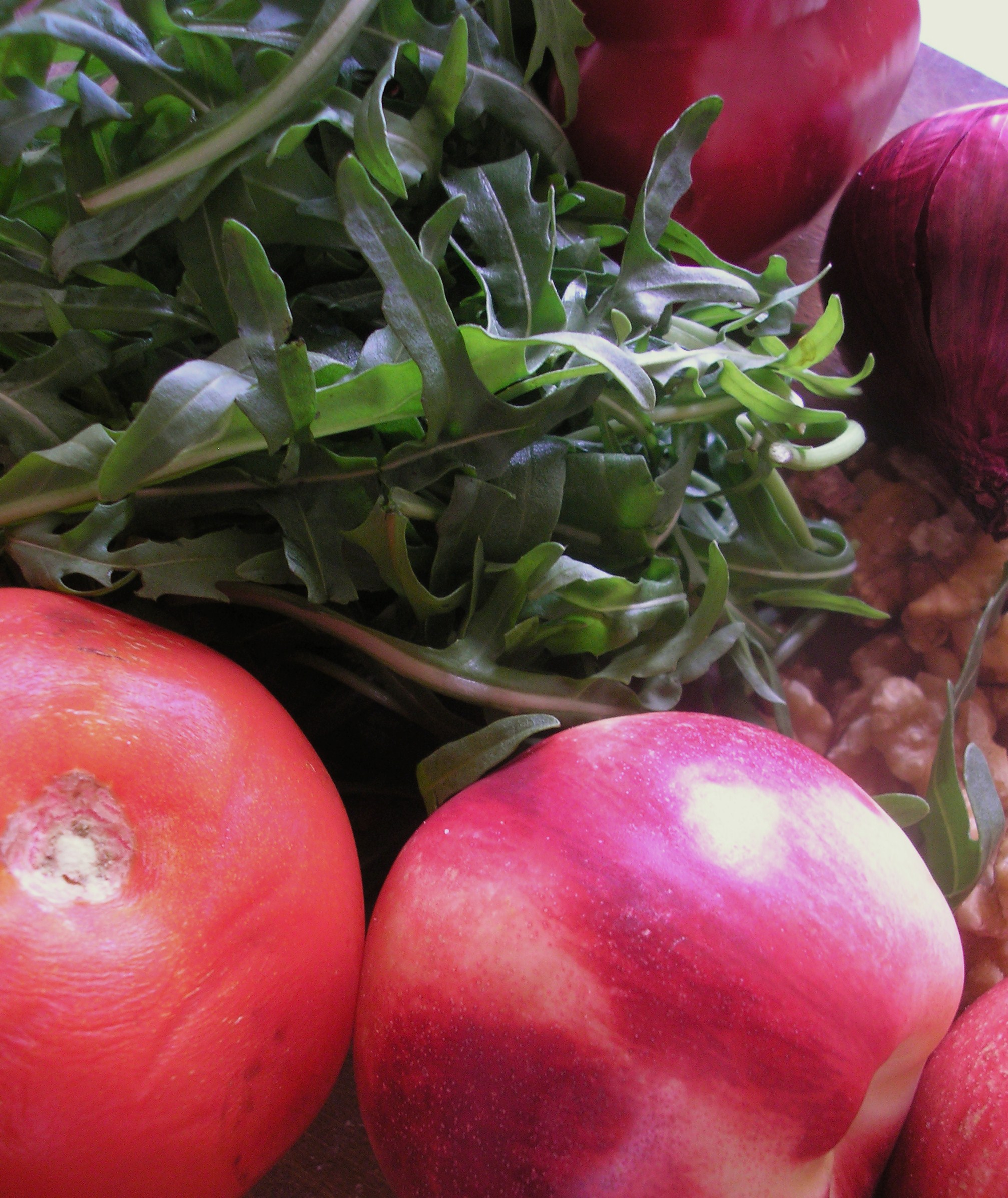
To return to the supermarket, I bought a couple of vine ripened truss tomatoes (expensive but the only ones I can find of decent quality, can’t wait for Mum and Dad’s homegrown tomatoes in a week or two), one red capsicum, half a dozen reasonably priced nectarines, one red onion, walnuts and some loose rocket leaves.  To supplement this meagre haul of fruits and vegetables I plan to use some of our herbs that we grow in pots downstairs and some cupboard stores.

Slim pickings

Going up the country continued…

In Recipes on January 23, 2011 at 6:28 am

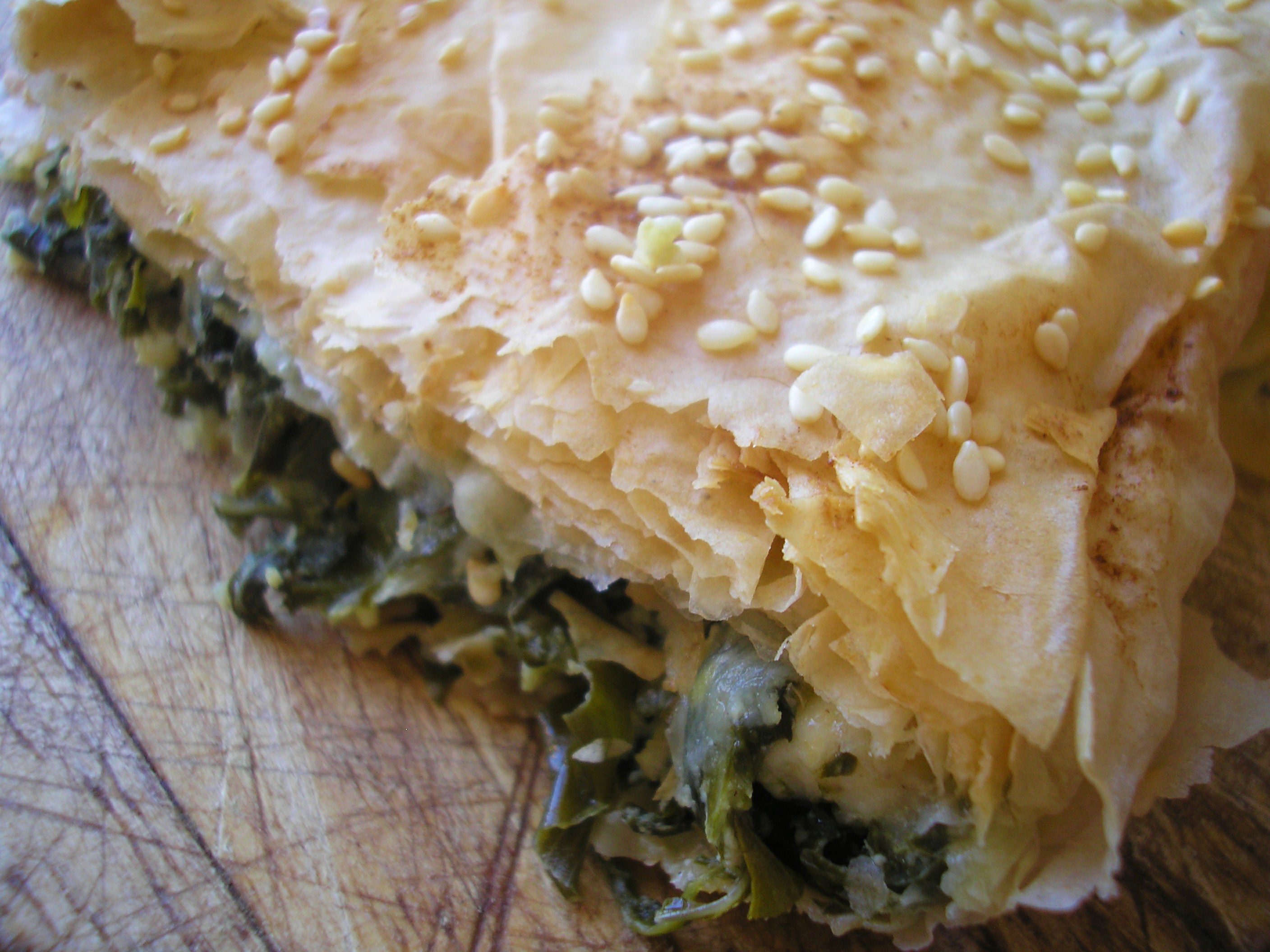
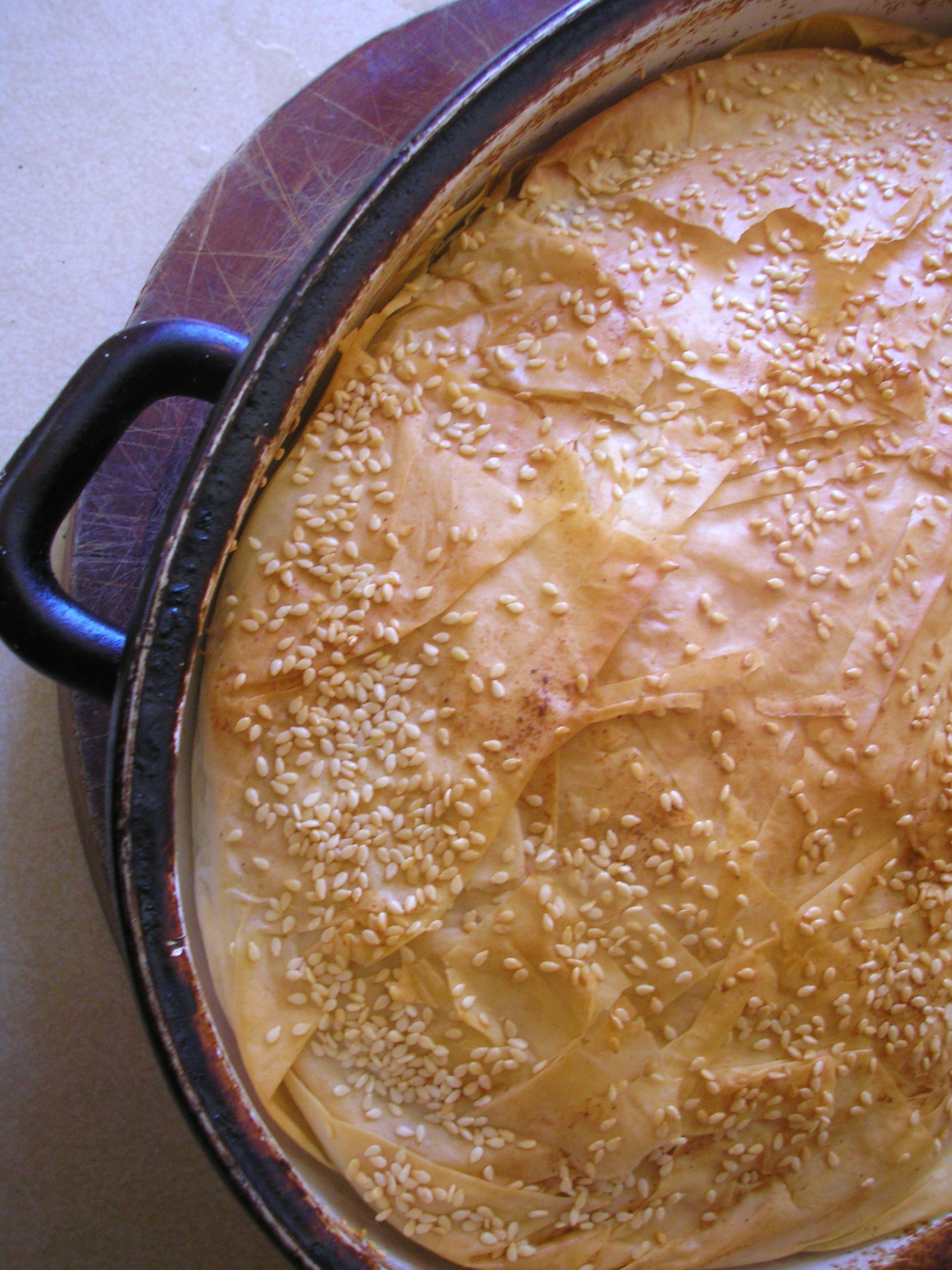
With the leaves I got from my parents’ garden I made a spanakopita.  I have been making this Greek spinach and cheese pie for more years than I care to remember.  The recipe has pretty much remained the same.

Flaky layers of filo

Spanakopita

Ingredients

500 g spinach leaves, or any other young leafy greens you may have, washed.

150 g feta cheese (crumbled)

100 g ricotta cheese

1/4 cup hard goat’s cheese (grated) or 1 tbs freshly grated Parmesan

1 free range egg

1/2 a small nutmeg (freshly grated)

1/4 tsp all spice

2 tbs chopped fresh mint

1/2 bunch spring onions (green part only, finely shredded)

freshly ground black pepper (no salt because the feta is quite salty, you could add a little to taste)

filo pastry (the one from the chiller cabinet is easier to work with than the frozen one)

Method

Roughly chop the spinach or greens.  Blanch in boiling water for 1 minute or until just wilted.  Drain in a colander and pour over cold water to stop the cooking process.  Squeeze the spinach with your hands over a colander.  When you have squeezed out most of the moisture, place in a large bowl.  Add the cheeses, spices, mint, spring onions and the egg. Mix thoroughly.

Spread your filo pastry on large bench.  Cover with a damp tea towel.  Melt 150g butter.  Grease the inside of a large baking dish with some of the butter.  Layer sheets of pastry, spreading butter with a pastry brush between each layer.  Leave some overhang as this folds in nicely later.  In the middle layer doubled over sheets of pastry, buttering between each layer.  Fold in the outer edges.  Brush with plenty of melted butter and sprinkle with sesame seeds (optional).

Bake on the second to top shelf in a 220C oven for 15 mins, turn and bake for a further 15 mins.  Reduce heat to 180C and cook for a further 20-30 mins, checking occasionally to make sure the pastry is not burning.  Rest for 10 mins before serving.

Crispy and golden

Going up the country

In Recipes on January 23, 2011 at 6:00 am

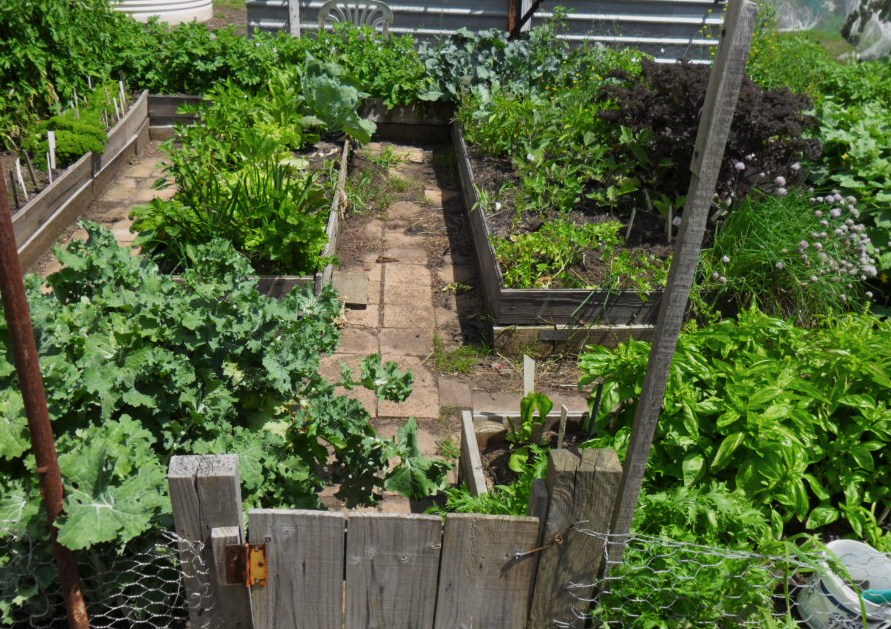
Mum and Dad's raised vegetable garden

Does anyone remember the old Canned Heat song?  It was even a bit before my time but my Dad had the record and I recall it being played a lot when they had their first try at sustainable living on a small country property outside Geelong.   Anyway, I was thinking of it as I journeyed on the train down to Mum and Dad’s on what I hope will be the first of many entries on my parents’ rather grandly named Cornucopia. I’m fairly sure the original Cornucopia didn’t involve “droughts and flooding rains’ not to mention hares, foxes and birds.  They battle on netting fruit trees and grape vines, locking up the chickens in their (hopefully secure) pen at night.

First batch of plums for the season

We arrived at their five acre place on the Bellarine Peninsula to be confronted by a greener prospect than we had seen for some time.  The recent rains have happily not flooded but rejuvenated.  We ate lunch in the shade looking out at the grape vines.  Highlights were the greens and broad beans from Mum’s garden and the aioli that Dad made, using an egg yolk from one of their bantam chickens.

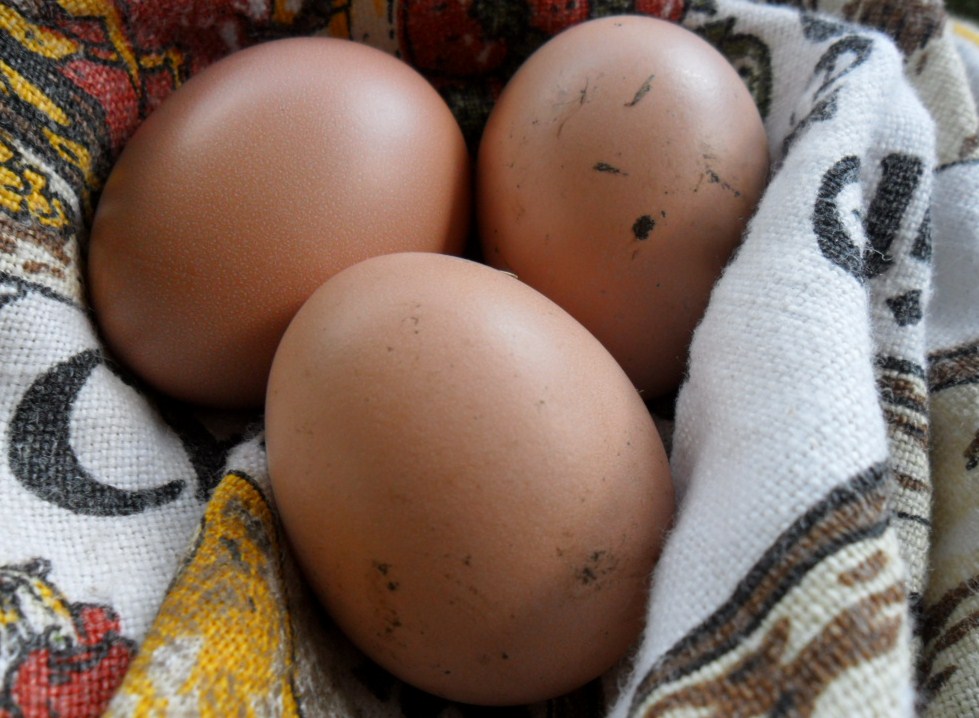
Fresh eggs

It sounds idyllic but the reality of rural life is absolute.  Even as an urban observer, I am worried about the chooks.  A couple of them have shuffled off this mortal coil since I last visited.  Now the new and bigger Rhode Island Red/White Leghorn cross pullets have the two remaining Chinese Silky bantams running scared.

Country life does provide some success stories.  Mum and I picked leaves from the garden, young silver beet, kale and mezzuna, along with herbs to supplement our own crops that we grow in pots downstairs.  I’d like to think this is a kind of symbiosis between city and country.  To keep up my own end I’d better take Dad a bag of Glick’s bagels next time.

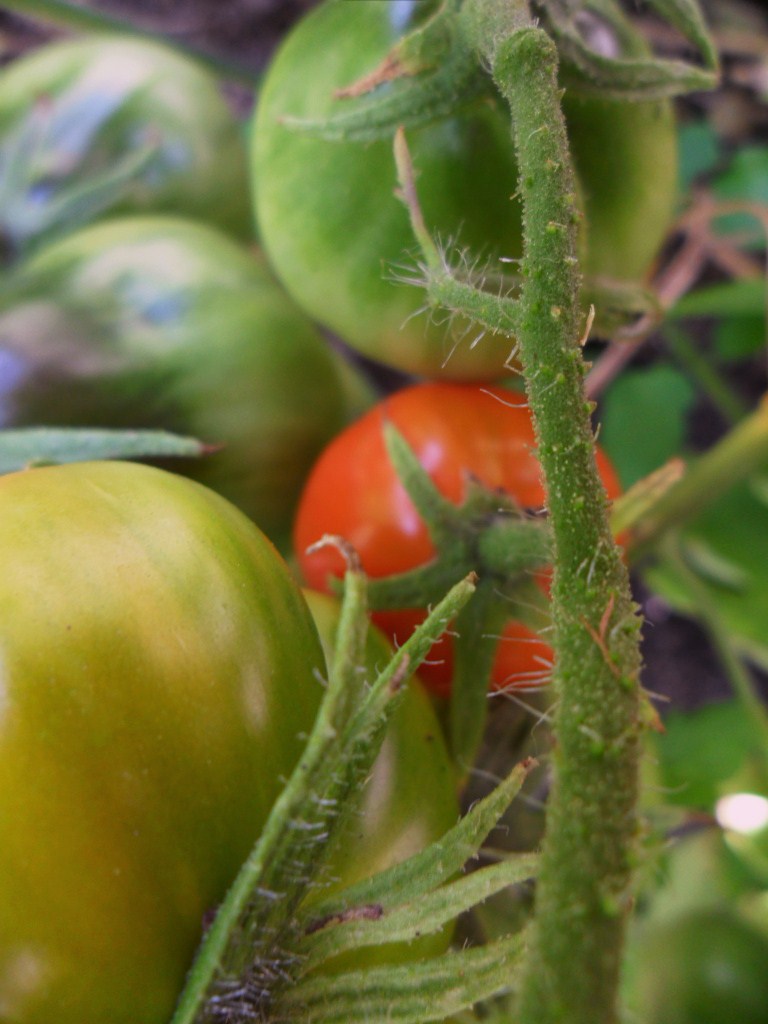
Different stages of ripening

The ‘Delightful’ Ms. David continued…

In Recipes on January 19, 2011 at 1:06 am

I first started making risotto with Eizabeth David’s ‘Risotto Alla Milanese’ from her book Italian Food.  Her version contains bone marrow and saffron but I have found the basic recipe works for any risotto.  Over the years I have made many versions including the one below with chicken and baby peas.

Chicken and pea risotto

Risotto with Chicken and Baby Peas

Ingredients

2 cups arborio rice

4 cups chicken stock (gently simmering)

1 large onion (chopped)

2 cloves garlic (minced)

30g butter

2 tbs olive oil

1/2 cup white wine

1 1/2 cups blanched baby peas (fresh or frozen)

1 free range chicken breast (poached for 20-25 minutes in gently simmering water and allowed to cool in its own stock)

1/2 cup freshly grated Parmesan cheese

Fresh parsley and basil

Method

Heat olive oil and butter in a large heavy based pot.  Gently cook onions and garlic until translucent.  Add rice and cook for a few minutes, stirring, until each grain of rice is well coated in the oil.  Add white wine and cook for a further few minutes until the wine has been absorbed by the rice.  Add the hot stock one ladle at a time and continue stirring until each one has been absorbed.  When absorbed, add another ladle, stirring all the time.  Continue until you have used up almost all of the stock (reserving a little to finish).  Stir through Parmesan cheese and a knob of butter (optional).  Stir through blanched peas and chopped chicken breast.  Finish with some chopped basil and parsley and the last of the stock.  Season to taste.  Serves four.

If you have any risotto left over you can make arancini balls.  Take some of the cold risotto mixture, press a piece of fior di latte or buffalo mozzarella into the middle.  Roll into a ball.  Coat in flour, egg and Japanese panko breadcrumbs.  Refrigerate until firm.  Deep or shallow fry until golden.  Drain on a rack and keep warm in the oven until ready to serve.

A hearty meal