notimeforporridge

Archive for the ‘Recipes’ Category

The Road to Morocco

In Recipes on June 24, 2011 at 4:13 am

From Spain it is only a short trip over the Strait of Gibraltar to Tangiers in Morocco.  I haven’t been to Morocco but I have been fascinated with the place (and North Africa in general) since reading Paul Bowles’ The Sheltering Sky many years ago.  Before I die I definitely want to visit the souqs, spice markets and medinas of Tangiers, Marrakech and Fes.  Moroccan cuisine is now fairly well known around the world with the most famous dishes being tagine (a type of  stew named after the conical lidded pot in which it is cooked, there are endless variations) and cous cous.  These are, of course, a huge part of Moroccan cuisine but I thought I would look around for something different.  I found it in Meera Freeman’s A Season in Morocco.  A specialty of the region around the small town of Rissani on the edge of the Sahara, Medfouna is a type of flat bread stuffed with meat, onions and spices –  including the famous Moroccan spice mix Ras el Hanout.  The semolina dough takes a little work but it is worth it, the resulting dish is delicious.

Medfouna

Medfouna

Ingredients

For the dough:

500g plain flour

500g fine semolina

30g fresh or 1 sachet active dry yeast

1 tsp salt

2 cups lukewarm water

For the filling:

5oog beef mince (lamb mince is good too)

1 large onion (finely chopped)

1/2 cup flat leaf parsley (finely chopped)

1 tsp salt

1 tbs cumin

1 tsp freshly ground black pepper

1/2 tsp hot paprika

1 tsp Ras el Hanout

Method

Mix the yeast with 2 tbs of water with a tsp of sugar and leave for 5 mins. or until it starts to bubble.  In a large bowl combine the flour, semolina and salt.  Add just enough water to form a stiff dough.  Cover and leave for 15 mins.  Knead vigorously, gradually knuckling in the rest of the water and kneading for 20 mins. until the dough is pliable and elastic.  Cover and set aside to rise for an hour.

Mix the mince with the onion, parsley, salt and spices.  Knead with your hands to combine well.  Divide the bread dough into 4 pieces.  Roll out one of the pieces to a disc about 1 cm thick (even thinner is better) and spread it with 1/2 the filling, leaving 3cm around the edges.  Make a disc with the second piece of dough and place it on top.  Seal the edges and shape the whole into a round, flat loaf.  Repeat with the other 2 pieces of dough and the other 1/2 of the filling.  Cover the loaves and set aside to rise for an hour or so.  Prick the top in several places to allow the steam to escape.  Bake in a hot oven (210c) for 30-40 mins. until golden brown.

Ras el Hanout

Ingredients

2 tsp ground ginger

2 tsp ground cardamon

2 tsp ground mace

1 tsp ground cinnamon

1 tsp ground allspice

1 tsp ground coriander

1 tsp ground nutmeg

1 tsp turmeric

1/2 tsp ground black pepper

1/2 tsp ground white pepper

1/2 tsp ground cayenne pepper

1/2 tsp ground anise seeds

1/4 tsp ground cloves

Method

Mix all ingredients together.  Store in an airtight container in a cool, dark place until ready for use.
Time for Tapas

In Recipes on June 17, 2011 at 5:52 am

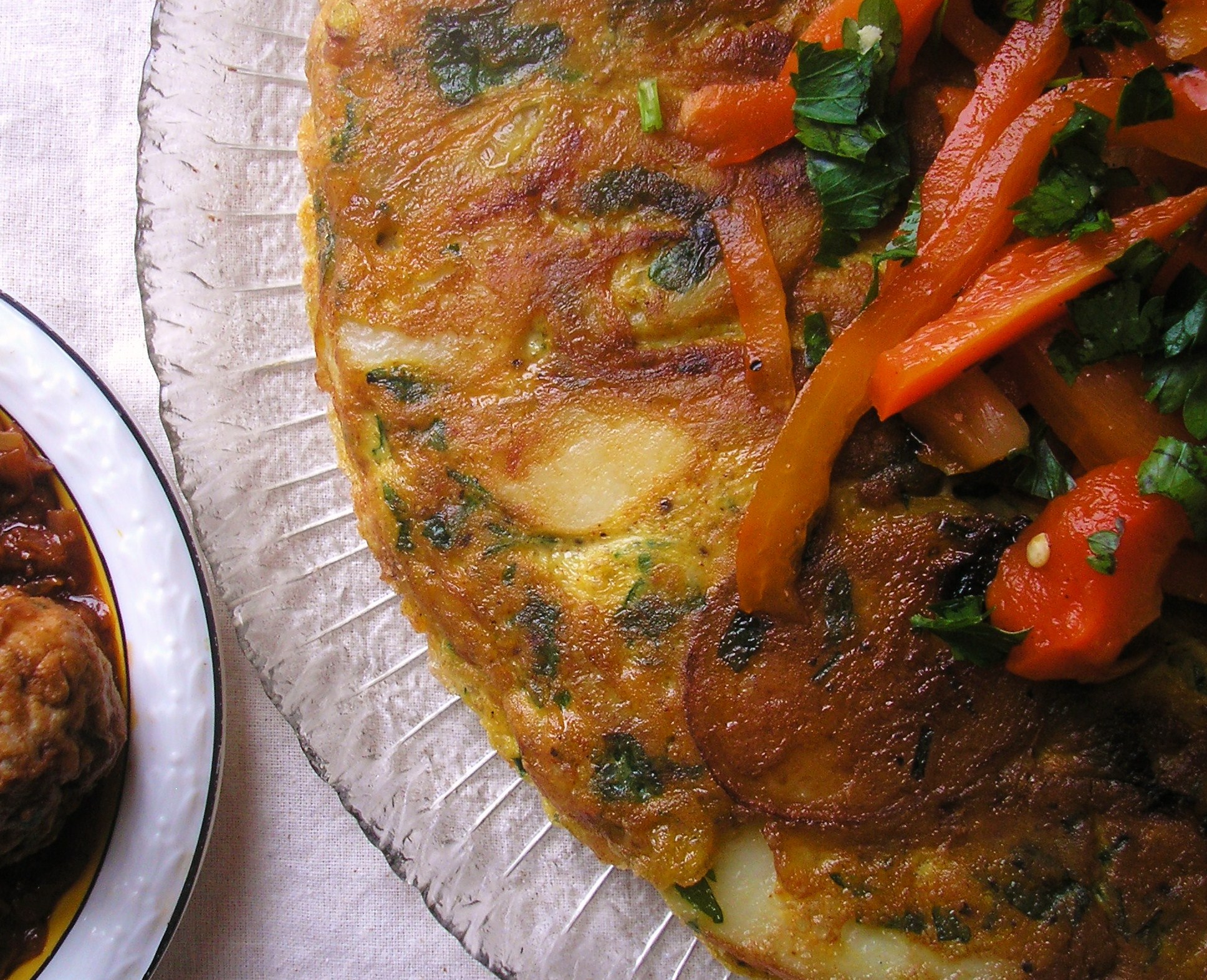
After a recent trip to my parents’ place on the Bellarine Peninsula I sat at home trying to think what I could do with the beautiful  freshly laid eggs they had given me.  Tortilla de Patata or Spanish Potato Omelet seemed an obvious choice.  When most people think of tortillas they think of the corn or flour tortillas of Mexico.  Delicious though these are, the Spanish tortilla is different being more like an Italian frittata.  Cut into small wedges it is a common dish in tapas bars throughout Spain and, indeed,  the rest of the world.  In its simplest form it is just potatoes, onions, eggs and plenty of olive oil.  I added some chopped parsley and paprika for a bit of extra flavour.  Other ingredients you could add are chopped cooked chorizo, chopped roasted red peppers, chopped pitted olives – the possibilities are  endless.  Just remember that the potatoes are supposed to be the feature of this dish.

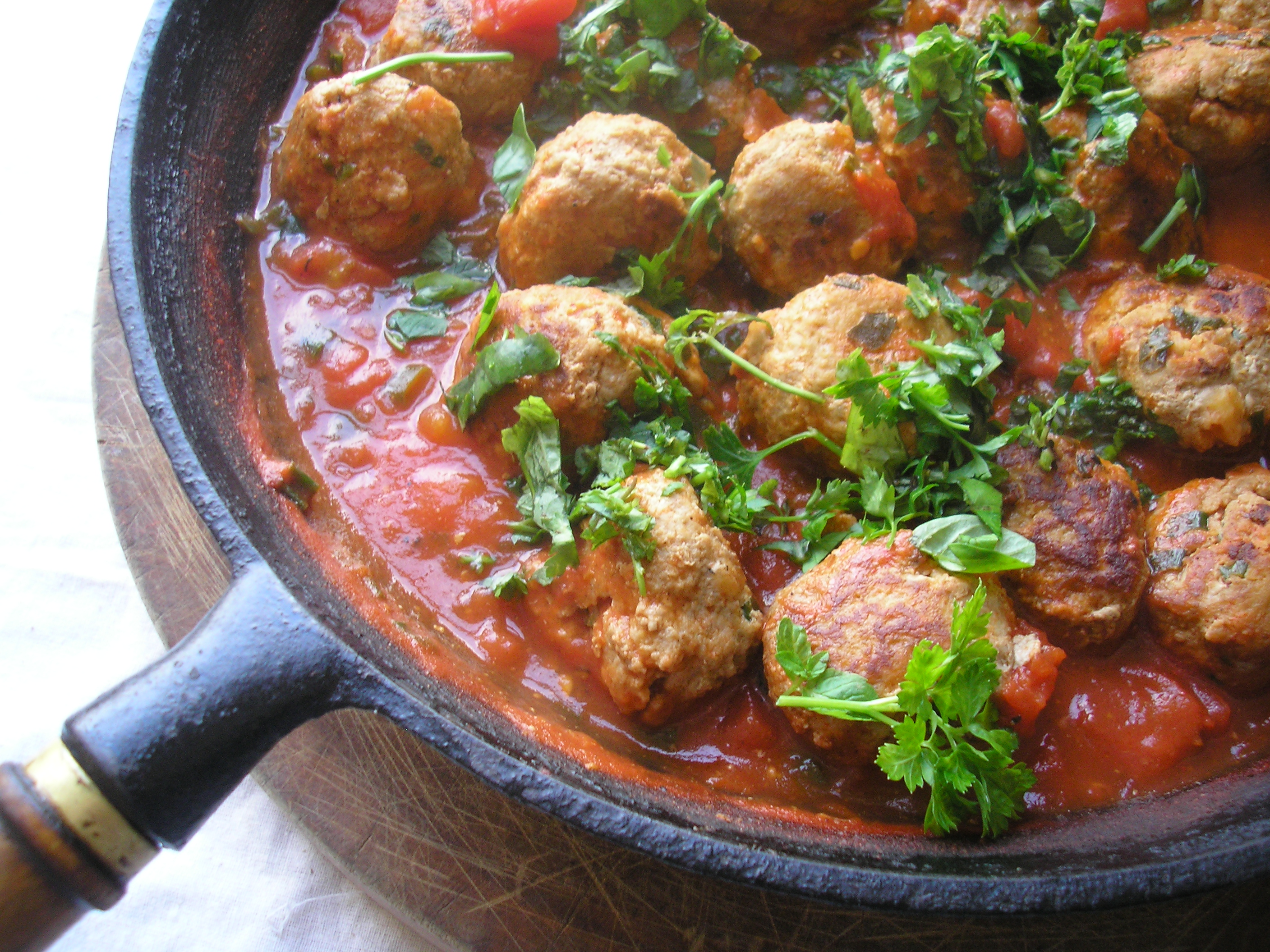
To go with the Tortilla de Patata I made another common tapas dish.  These tasty little meatballs in a rich, red wine sauce are called Albondigas.  In a tapas bar four or five of them would normally be served, as a snack, in a little flat earthern ware bowl.  If you wanted them as a meal you could serve a few more of them with a wedge of Tortilla de Patata and a salad.

Tortilla de Patata

Tortilla de Patata 

Ingredients  

6-7 medium potatoes (peeled)

1 onion (peeled)

5-6 large eggs

2 tbs flat leaved parsley (finely chopped)

1 tsp paprika

1 cup olive oil

sea salt and freshly ground black pepper

Method  

Cut the peeled potatoes into slices about 3-5 mm thick.  Season.  Halve the onion and finely slice.  Set aside.  Heat about a 1/2 cup of oil in a large, heavy based frying pan over medium heat.  Not too hot!  Gently cook the slices of potato in batches adding the onions with the last batch.  Try to make sure the potato slices are covered in the oil.  The potatoes are not meant to be brown, just cooked through and tender when pierced with a fork.  Remove and drain.

Whisk the eggs with the parsley, paprika and salt and pepper.  Add the potatoes and onions and mix well to make sure all the slices are coated in the egg.  Heat 2-3 tbs olive oil in a heavy based or non stick pan.  Use a pastry brush to oil sides of pan.  Pour in the potato and egg mixture making sure to spread it out evenly.  Allow the egg the cook around the edges then carefully lift the side of the tortilla to see if the bottom has browned.  When brown invert the tortilla on to a large plate.  Put a little more oil in the pan and slide the tortilla back in.  Cook for 3-4 mins.  Slide on to a plate to serve.

Hint:  if you are a bit apprehensive about inverting the tortilla on a plate and then sliding it back into the pan you can just brown the top of the tortilla under an overhead grill, let it cool a bit and then invert it on to a plate to serve.

Albondigas

Albondigas or Spanish Meatballs  

Ingredients  

600 g pork mince

3 tbs Italian parsley (finely chopped)

1-2 cloves garlic (minced)

1/3 tsp ground nutmeg or 1/3 of a whole nutmeg (grated)

1/3 cup milk

1/4 cup breadcrumbs

1 large egg (beaten)

2 tbs olive oil

2 onions (finely chopped)

1 tbs flour plus more for dusting the meatballs

1 tbs tomato paste

1 bay leaf

1 cup red wine

1/2 cup water

sunflower oil for frying

sea salt and freshly ground black pepper

Method  

Soak breadcrumbs in the milk.  Set aside.  Mix pork mince, parsley and garlic together.  Refrigerate.  Heat the olive oil n a large, heavy based pan.  Add the onions and cook until soft (about 5 mins).  Add tomato paste and stir for 1 min.  Sprinkle in the flour and cook for 1 min.  Add wine and bay leaf, reduce to a low simmer.  Add water and salt and pepper.  Cook gently for 15 mins or until sauce has lightly thickened.  At this stage you can sieve the sauce for a smoother result.  I didn’t bother.  Set sauce aside.

Squeeze milk from breadcrumbs and add to meat mixture along with the egg and 2 tbs of the wine sauce.  Season with salt and pepper.  Mix well.  Roll into small balls about the size of a golf ball.  Dust with flour.  Heat about 1 cm of sunflower oil in the bottom of a heavy based pan.  Fry the meatballs until brown, turning occasionally and shaking the pan gently to make sure they aren’t sticking.  Remove from pan and drain on a wire rack.  Drain oil from pan, add wine sauce, stir.  Add meatballs to sauce and simmer until meatballs are cooked through.  Serve sprinkled with chopped parsley.

South of the border, down Mexico way…

In Recipes on June 6, 2011 at 4:46 am

Don’t stray down there folks or you’ll end up betrayed, lovelorn and left for dead, just like the girl in the Patsy Cline song.  Seriously though, I haven’t cooked any Mexican food for a while* so I thought it was time to look for some new Mexican recipes.  I have been reading, My Mexico, by Dianne Kennedy, this substantial book is a travelogue and food guide to Mexico and its diverse regions but its main focus is the over three hundred recipes contained within its solid covers.  This one for Pollo Almendrado or Chicken in Almond Sauce is from the fertile valley town of Oaxaca in Southern Mexico.  I have altered the recipe slightly by roasting my chicken to my own specifications  rather than poaching it as Diane Kennedy does.  I have then made the sauce separately.  You could serve this sauce with other meats such as beef or pork and it would work just as well.

Almendrado Sauce

Pollo Almendrado or Chicken in Almond Sauce

Ingredients

For the chicken:

1 free range chicken (about 1.5-2 kg)

2 jalapeno chillies (quartered lengthwise)

1 lime (quartered)

1 lemon (quartered)

4 cloves garlic (roughly chopped)

1 cinnamon stick

olive oil

1 tsp dried chilli flakes

1 tsp sweet paprika

sea salt and freshly ground black pepper (to taste)

Stuff the cavity of the chicken with the chillies, citrus, cinnamon stick and garlic pieces.  Rub the outside with olive oil.  Season. Sprinkle with chilli flakes and paprika.  Roast in the usual manner**

For the sauce:

1 tin diced Italian tomatoes

sunflower oil for frying

1 1/2cups raisins

1 cup slivered almonds

3 garlic cloves (roughly chopped)

1 medium brown onion (sliced)

1/2 a slightly under ripe banana or plantain (chopped)

1 slice rich bread such as challah (cubed)***

1/3 cup sesame seeds

1/2 cinnamon stick

2 whole cloves

2 whole black peppercorns

3 cups chicken stock

1 sprig flat leaved parsley

sea salt and freshly ground black pepper

To finish: 1 jalapeno chilli, 1 long red chilli, 1 long green chilli (chopped), 1 lime

Method

Place a little olive oil in a pan and toast the sesame seeds until golden brown and fragrant.  Remove from pan and set aside.  Put a little more oil in the pan and brown the almonds, onions, garlic, bread and raisins adding them in that order.  Remove from pan and set aside to cool.  Put 1 cup chicken stock in a food processor or blender.   Add the torn parsley and the sesame seed a bit at a time.  Blend until smooth.  Gradually add the almond and raisin mixture along with another cup of chicken stock.  When smooth transfer to a lightly oiled pot, add tomatoes, cinnamon, cloves, black peppercorns and another cup of chicken stock.  Season and simmer over a low heat for 1 1/2 hours or until sauce has reduced to 1/3 of its original volume.  Make sure to stir regularly as the sweet raisins in the sauce make it prone to ‘catching’ on the bottom of the pot.  I finished my sauce with 1 chopped jalapeno chilli, 1 chopped long red chilli and i choopped long green chilli.  A squeeze of lime juice or lemon juice just adds the final touch.

* see ‘Fire in the Mole‘ and ‘ I feel a hot wind on my shoulder…

** see ‘You may have the parson’s nose

*** you could use brioche or pannettone

Easy Chicken and Leek Pie

In Recipes on May 27, 2011 at 4:32 am

Throughout his childhood, whenever my son was asked what he would like for dinner, his choice would almost always be Chicken and Leek Pie.  Not Chicken and Mushroom, not Chicken and Vegetables, it had to be Chicken and Leek.  The mild onion flavour of the leek, combined with the chicken and a creamy white sauce, all steaming hot in a crisp butter pastry crust is, I’ll agree, a delicious combination.  These days, thankfully, his palate has matured and he is a little more adventurous though he still loves his Chicken and Leek Pie.  Now that he (occasionally) cooks for himself he has also realised how easy it  is to make.  Here’s the recipe.

Chicken and Leek Pie

Chicken and Leek Pie

Ingredients

For the pastry:

1 cup plain flour

1 cup SR flour

pinch of salt

125 g butter (chopped into small cubes)

1/2 cup water

For the filling:

600 g free range chicken breast or thigh* fillets (cubed)

2 leeks (washed, trimmed and finely shredded)

2 tbs flour

1 1/2 tsp Dijon mustard

1/2 tsp dried thyme (use a sprig of fresh if you have it)

100 g butter

1/2 cup milk

1/2 cup chicken stock

1/2 a freshly grated nutmeg

pinch of all spice

freshly ground sea salt and black pepper to taste

Method

For the pastry: Sift flour, add salt, rub in the butter lightly with the tips of the fingers until the mixture resembles breadcrumbs.  Make a well in the center and add water.  Bring together to form a firm dough leaving the sides of the bowl clean.  Refrigerate for 30 mins.  Roll 2/3 of the pastry out and line the bottom of a pie or flan dish.  Blind bake on the middle shelf of a 200 c oven for 15-20 mins.  Remove and allow to cool.  Roll out remaining piece of pastry and set aside for the top of the pie.

For the filling:  Melt butter in a pan until bubbling, add leeks.  Fry until translucent.  Add chicken, dried herbs and spices, toss for 1-2 mins.  Reduce heat, sprinkle flour over the chicken, cook off flour for 1-2 mins. without browning  Gradually start adding milk, stirring all the time, then add chicken stock.  Stir through Dijon mustard.  Simmer for five minutes or until sauce has thickened.  Season to taste.  Allow to cool.

Fill pie crust with the chicken mixture.  Cover with pastry top and glaze with egg wash (1 egg whisked with a little milk).  Cook in a 220 c oven for 15 mins.  Turn and reduce heat to 180 c.  Cook for a further 30-45 mins or until the crust is golden brown.

Hint

It is all right to use frozen pastry sheets if you are pressed for time, the result is still pretty good.  You can also make little individual pies in ramekins with pastry just on the top.

Winter treat

* Note: thigh fillets may require a bit more cooking time

Vegetarian ‘comfort food’

In Recipes on May 17, 2011 at 5:05 am

With the cold weather we have been experiencing lately the people in our house were craving something warm and comforting.  No-one wanted meat so a bouef bourguignon was out of the question.  Soup was a possibility but we couldn’t agree on a particular recipe as we all have our own favourites.  I suggested Spinach and Ricotta Lasagne (a recipe I have been making for more years than I care to remember) and finally a consensus was reached.  Lasagne is great for cold days as it is very satisfying, it is also good when you want to feed a lot of people with a minimum of effort as it can be made ahead of time and shoved in the oven when needed.  I prefer to make my own lasagne sheets but it is acceptable to use the commercial variety if you are pressed for time.

Pasta sheets drying on clothes rack

Spinach and Ricotta Lasagne

Ingredients

For the pasta:

3 cups ‘oo’ flour

3 large eggs

2 tbs olive oil

pinch salt

For the filling:

300 g spinach leaves (picked and washed)

300 g ricotta cheese

1/3 cup freshly grated Parmesan cheese

1 large onion (finely chopped)

1-2 cloves garlic

1 tsp dried basil

1 tsp dried oregano

1/2 a nutmeg (freshly grated)

1/2 tsp ground all spice

1 egg

sea salt and freshly ground black pepper (to taste)

1 tin diced Italian tomatoes

For the bechamel sauce:

75 g butter

1/2 cup flour

2 cups milk

bay leaf, freshly grated nutmeg and seasoning (to taste)

Washed and picked spinach leaves

Method

For the pasta:  Mound flour on a clean work surface.  Add salt.  Make a well in the center.  In the well place the three eggs and the oil.  Bring the flour into the middle with your hands and work the mixture until you have a firm dough.  Knead for 5-10 mins. or until smooth.  Wrap in cling film and rest at room temperature for 20 mins.  Divide dough into thirds.  Roll each piece out to a large sheet about 2-3 mm thick.  Hang sheets over a clean towel rail or clothing rack for 15-20 mins to dry.  Cut to required size.  For the filling:  Fry onion and garlic in a little olive oil until translucent, add dried herbs and cook for a further 30 seconds.  Set aside.  Shred spinach leaves and place in a bowl with the ricotta, Parmesan, all spice, nutmeg, egg and seasoning.  Add cooked onion and garlic and mix thoroughly.  Set aside.  For the bechamel sauce:  Melt butter in a saucepan.  Add flour and cook for a couple of mins. to get rid of the floury taste.  Gradually add the milk, stirring all the time, until all the milk is used up and you have a smooth sauce.  Add bay leaf, nutmeg and seasoning.  Set aside.

Put a little of the diced tomatoes and 2 tbs water in the bottom of a lasagne dish.  Cover with a layer of pasta.  Spread about 1/4 of the ricotta mixture on top, sprinkle with some more of the diced tomatoes and a little of the bechamel sauce making sure you keep about 1/2 to cover the top.  Repeat with the remaining layers finishing with a layer of pasta.  Cover with bechamel sauce and extra freshly grated Parmesan cheese.  Cover with foil and place in a pre-heated 180 c oven for 30 mins.  Remove foil and bake for another 30 mins. or until golden brown.

Golden brown and bubbly

Salt of the earth, fish of the sea

In Recipes on May 5, 2011 at 5:21 am

I have been reading Salt: a World History by Mark Kurlansky.  Though you may think a history of salt doesn’t sound very exciting it was (surprisingly) compelling.  I didn’t realise how many settlements had been settled, fortunes made and lost, wars fought – over plain old salt.  The fact that everyone needed salt, for their health, to add flavour to cooking, for preservation in the times before canning and refrigeration, for vital chemical processes (one of the earliest being the dyeing of fabric), meant that that the person or administration that controlled the local salt trade, quickly became very rich indeed.  The ruling elite soon realised that there were other ways to make money out of salt –  some of the first taxes ever imposed were salt taxes.  Of course, everybody had to pay them because, rich or poor, they all needed salt, making these taxes popular with despots and tyrants and extremely unpopular with the masses.

It was early in the piece that humans discovered a natural affinity between salt and the fishing industry.  In Roman times salt fish or salsamentum were already established as a lucrative trade item.  The innards and the scraps left over from the salt fish industry were placed in earthern jars with salt to produce the Roman condiment garum.  Even earlier than the Romans, the Chinese were also making a fermented fish sauce called jiang.  This, with the addition of soybeans and the removal of the fish from the recipe, eventually became soy sauce.  Fish sauce is, however, still widely used today throughout South East Asia.

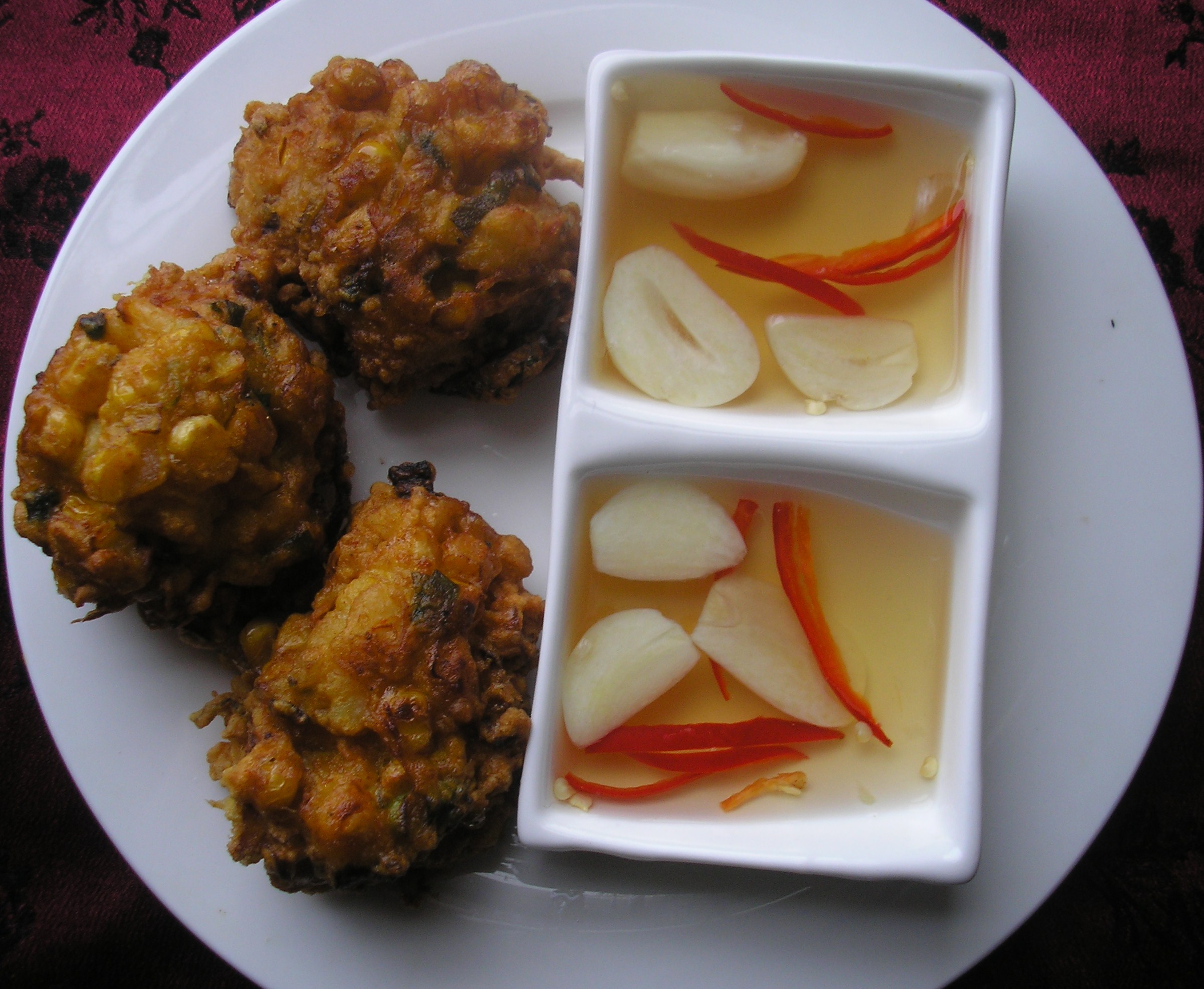
In Vietnam, instead of adding salt directly, the cook will often use fish sauce or nuoc mam to provide seasoning.  This is similar to the way Chinese cooks add soy sauce to their dishes.  Fish sauce is also widely used in Vietnam as a component of dipping sauces – these are served with almost every meal.  Here is a recipe for dipping sauce that I found in Luke Nguyen”s book, Songs of Sapa.  

Nuoc Mam Cham

Ingredients  

3 tbs fish sauce

3 tbs rice vinegar

2 tbs sugar

2 garlic cloves (chopped)

1 bird’s eye chilli (thinly sliced)

2 tbs lime juice

Method 

Mix the fish sauce, rice wine vinegar, sugar and 125 ml water in a small saucepan and place over medium heat.  Stir well and cook until just below boiling point.  Remove from heat and allow to cool.  To serve, add garlic, chilli and lime juice.  Will store for up to 5 days in a tightly sealed jar in the refrigerator.  I served mine with another of Luke Nguyen’s recipes, Prawn and Corn Fritters.

 Prawn and Corn Fritters

1oo g (1/3 cup) plain flour

1/2 tsp paprika

1/2 tsp ground turmeric

2oo g raw tiger prawns (peeled, deveined and roughly chopped)

2oog raw corn kernels (from 2 cobs)

2 spring onions (finely sliced)

1 garlic clove (finely chopped)

2 red Asian shallots (finely chopped)

2 eggs lightly beaten

vegetable oil for deep frying

125 ml nuoc mam cham (see above) for serving

Method

Combine the flour, paprika and turmeric, mix well.  Place the chopped prawns in a large bowl, season with 1/2 tsp  each of salt and freshly ground black pepper.  Add the corn kernels, spring onions, garlic, shallots and eggs.  Mix to coat the prawns, then gradually add the flour, mixing until well combined.  The mixture will be very thick.

Heat the vegetable oil in a wok to 180 c or until bubbles form around the handle of a wooden spoon inserted into the oil.  Shape the batter with two spoons or with your wet hands into small patties.  Drop into the hot oil and fry for 3-4 mins or until crisp and brown.  Remove and drain on a rack, serve immediately.

Luke Nguyen's Prawn and Corn Fritters

“You put the lime in the coconut…”

In Recipes on April 19, 2011 at 12:52 am

Limes were important to sailors in colonial times as a preventative for scurvy.  Lemons, though four times higher in Vitamin C than limes, were not always easy to find in the far flung colonies of the Caribbean and the Pacific.  West Indian limes grew prolifically on the Caribbean islands and it was easy for the sailors to take on a cargo of these while dropping off another cargo of supplies (or slaves to work on the sugar plantations).  In the Pacific Tahitian limes or their juice were also loaded onto ships to prevent scurvy.

In the last thirty years, due to the emergence of Asian cooking styles like Thai and Vietnamese, limes have also become an everyday ingredient in Australia.  Curries with Kaffir lime leaves, fish dishes ‘cooked’ in lime juice, satay sauce finished with a squeeze of lime juice.  Even indigenous finger limes are beginning to appear in fruit shops.

The lime tree that grows in a sheltered spot beneath the eaves of my parents’ house has done remarkably well.  Better than the poor lemon tree that gave up the fight some time ago.  The last time I was there my parents had more limes than they could use so I took home a bag.  I’m not used to having limes in such profusion and I had to look for new ways to use them.  Here’s one recipe I found credited to Donna Lee.

Lime Curd Tart

Tangy lime curd tart


Ingredients 

Pastry:

2 cups plain flour

1/4 cup icing sugar

pinch salt

180 g cold unsalted butter

2 tbs iced water

Filling:

275 ml pure cream

275 g caster sugar

200 ml lime juice

zest of 4 limes

8 free range eggs

Method

Grease a 22cm flan tin with a removable base

For the pastry:

Sift dry ingredients together.  Add chopped butter and rub until the mixture resembles breadcrumbs.  Add 2 tbs iced water to form a dough.  Flatten into a disk about 1 inch thick, cover with cling wrap and refrigerate 20 mins.

For the filling:

Whisk all ingredients together.  Cover and place in the refrigerator.

Roll out dough and use it to line your flan tin.  Make sure there are no holes.  Blind bake 20 mins at 180 c.  Cool.

Strain filling into the flan crust.  Reduce oven to 150 c and place carefully in the oven.  Cook 40 mins. or until filling has set.  Refrigerate 1 hour before serving.

Everyone will like this!

Quick and easy kofte

In Recipes on April 12, 2011 at 4:10 am

Turkish Kofte  or Lebanese Kafta are just a little flavoured meat patty, generally cooked over a grill.  There are further variations of these across the Middle East, North Africa, the Mediterranean, India and Pakistan.  You could even argue that we have had our own version here in Australia in the much maligned ‘rissole’.  Maybe not.  The version I make changes all the time, one constant being that I generally use lamb mince.  Though I do find they work pretty well with beef, pork or even turkey mince.

Kofte

Ingredients

1 kg lamb mince

1 large onion (finely diced or minced)

2 tbs each of chopped fresh mint, parsley and coriander

2 tsp cumin powder

2 tsp coriander powder

1 tsp sumac

1 tsp chilli powder

1 tsp all spice

sea salt and freshly ground pepper (to taste)

Method

Place all ingredients in a large bowl.  Use your clean hands to mix well.  Refrigerate for 1/2 an hour.  Mould into small oval shaped patties.  Refrigerate 1 hour.  Brush with olive oil and place on or under a hot grill.  Cook, basting with olive oil and turning regularly until they are nicely brown.  Serve with lettuce, tomatoes, yoghurt or tahini sauce and flatbread.  Serves 6.


Thrifty times

In Recipes on April 1, 2011 at 4:16 am

The cost of living is going up.  Utility bills, petrol prices, rents and mortgages, groceries – the only thing that never seems to go up is wages.  Even so called middle class households are doing it tough.  As a consequence the greed and rampant consumerism that characterized the eighties, nineties and early ‘noughties’ is out of vogue and thrift is most definitely in.  Come to think of it, for those of us who have always tried to live a sustainable life, it was never really out.  Wastage and over consumption have never been ‘green’.

Food is a big part of the household budget so it an obvious area where you can save money and cut down on wastage at the same time.  In every house’s budget there is always room for improvement.  One way of saving money at the supermarket is to ‘mix it up’.  I shop regularly at Coles, Woolworths, Aldi along with various Asian, Middle Eastern, Indian, Mediterranean, Vietnamese etc. markets and supermarkets.  This is why I eschew  ‘rewards’ cards as these cards are trying to lock you into shopping at one place.  Ultimately you will pay more and, with less competition in the marketplace, so will everyone else.  Unless I am making a specific dish for a special occasion, I try not to go shopping with a fixed idea in my mind of what I am going to make.  While there I’ll make my purchasing decisions based on what is on special and what is in season.

Then there are the cheaper ingredients.  Just because you are trying to save money you don’t have to eat bad food.  Buy good quality mince and get it on special when you can; buy a whole free range chicken instead of just the breast fillets and use the whole bird, saving the carcass and wings to make stock; buy the cheaper cuts of meat and use long, slow cooking and the addition of herbs and spices to transform them; buy the more expensive cuts of meat in smaller quantities – make a stir fry that uses vegetables and/or noodles with only a small amount of meat.  Eat vegetarian food a few times a week.  Vegetables, as long as they are in season (and barring natural disasters) are usually pretty cheap.  Supplement these with Italian tinned tomatoes, tinned and dried pulses and frozen peas.  Cheese, eggs and tofu are also good, cheap ingredients to bulk out vegetarian food.  Finally, make sure you have a well stocked spice cupboard and a few herbs in pots.  Of course, if you have the space (many people don’t) a vegetable garden is good but it is surprising how much flavour you can add to food with just a few well chosen spices and some fresh herbs.

The recipe here provides a good, tasty meal at a bargain price.

Italian Meatballs

Italian Meatballs

Ingredients

For the meatballs:

5o0 g pork and veal mince (beef mince and turkey mince are also good)

1/4 cup breadcrumbs

1/4 cup freshly grated Parmesan

1 tsp Dijon mustard

2 tsp tomato paste

1 tbs finely chopped fresh oregano

1 tbs finely chopped basil leaves

1 tbs finely shredded spring onions

freshly ground black pepper and sea salt to taste (remember the Parmesan is quite salty)

seasoned flour

1 tbs each of olive oil and sunflower oil and a small knob of butter

For the sauce:

450 g tin diced Italian tomatoes

1 onion (finely chopped)

1-2 cloves garlic (finely chopped)

1/cup chicken stock

pinch of all spice and salt and pepper to taste

chopped fresh herbs

Method

Place all the meatball ingredients together in a large bowl.  Mix well, I find clean hands the best way to do this.  Shape into small balls and roll in the flour.  Refrigerate 1 hour.  Heat oil and butter in a heavy based pan.  Fry meatballs until golden brown, shaking the pan occasionally to make sure they brown on all sides and don’t catch on the bottom of the pan.  When brown remove from pan and set aside.

Drain a little oil from pan (if necessary) and add chopped onion and garlic.  Cook gently for 1-2 mins.  Add diced tomatoes, all spice and chicken stock.  Season to taste.  Reduce on high for ten minutes.  Return meatballs to pan and reduce to a simmer for a further 20 mins. turning the meatballs occasionally to make sure they get a good dousing in the sauce.  Finish with fresh herbs and freshly grated Parmesan.  Serve with spaghetti or polenta.  Serves 4.

Stay tuned for Pea and Ham soup.

I can’t believe it’s not goulash!

In Recipes on March 22, 2011 at 7:08 am

Even in Hungary every home cook has their own version of gulyas or goulash as it has become known.  Originally made by Hungarian herdsmen (gulyas) this thick soup, based primarily on onions, paprika and beef, has become the Hungarian national dish.  Then there is porkolt.  This is often confused with goulash the difference being that beef is not the only meat used and vegetables like carrots and potatoes are not added.  Other variations include a Transylvanian dish known as tokany in which paprika is not the main ingredient the emphasis being on black pepper and herbs like marjoram instead and where mixed meats are used.  There are also variations of goulash and porkolt throughout Eastern Europe; porkelt in Slovakia, porkolt in the Czech Republic and gulansz in Poland, a dish that blurs the lines still further as it is more like porkolt than goulash.  Perhaps you can now see how people have become confused.

My own version of goulash borrows from all of these recipes and adds a little sausage as well.  It is not an authentic Hungarian goulash but it is still very tasty.

Goulash and noodles

Goulash

Ingredients

500 g gravy beef or chuck steak (well trimmed and chopped into small cubes)

2 smoked Kransky sausages

2 large onions (chopped)

2 carrots (finely diced)

1 red capsicum (de-seeded and finely diced)

2 tbs Hungarian sweet paprika

1 tsp ground caraway seed

1 450 g tin diced Italian tomatoes

2 medium potatoes (peeled and diced)

1 cup water

freshly ground black pepper and sea salt (to taste)

2 tbs chopped flat leaved parsley

2-3 tbs olive oil

Method

Heat oil in a large, heavy based pot.  Add onions and cook until translucent.  Reduce heat and add paprika.  Stir until paprika is lightly toasted but not burnt.  Add diced beef, capsicum, carrots and caraway, toss well in the onions and paprika.  Add 1/2 cup water, cook for 5 mins.  Add the rest of the ingredients apart from the sausages, potatoes and parsley and simmer for an hour.  Add the whole sausages and diced potatoes and simmer for a further 45 mins.  Remove sausages and slice thinly, return to the pot and simmer for a further 15 mins.  Add chopped parsley and serve with buttered noodles.

Hint

To make your goulash more authentic omit the sausages, capsicum and tinned tomatoes.  Use 800 g diced beef and use a bit more water.  Simmer for 1 hour and 45 mins.  Add a sliced green capsicum and a couple of diced fresh tomatoes, simmer for a further 15 mins.  Add chopped parsley and serve.