notimeforporridge

Archive for the ‘Recipes’ Category

A taste of Spain

In Recipes on January 10, 2012 at 4:49 am

The other day I felt like making a stew.  In the refrigerator I had some veal chuck steak and a couple of chorizo sausages.  The obvious choice seemed to be a stew with Spanish flavours.  What I came up with is very similar to the goulash I make but I used chorizo instead of kransky sausages and smoked paprika instead of Hungarian sweet paprika.

Hearty and satisfying

Veal (or beef) and chorizo stew

Ingredients

750g veal or beef chuck steak (trimmed of sinew and cubed)

2 onions (finely chopped)

2 cloves garlic (minced)

1 red capsicum (deseeded and finely chopped)

2 chorizo sausages (diced)

2 tsp smoked paprika

pinch allspice

1/2 tsp dried thyme OR sprig of fresh thyme

1-2 bay leaves

1 tbs tomato paste

1 400g tin Italian diced tomatoes

2 tbs sunflower oil

water

Method 

Heat a heavy based saucepan, add a little of the oil and brown the meat.  Remove and set aside.  Add a little more oil and fry the chorizo sausage until it starts to render its own fat.  Add the onions and capsicum, fry gently, add the garlic and fry for a further 30 secs.  Add the smoked paprika, allspice bay leaves and thyme and fry gently until aromatic.  Add tomato paste and fry for 30 secs.  Add one tin of diced tomatoes and one tin of water.  Bring to the boil, cover and simmer gently for 1 1/2 hours stirring occasionally.  Remove lid and reduce sauce gently for 30 mins.  Serve with something to soak up the sauce.

Currying f(l)avour

In Recipes on January 3, 2012 at 12:34 am

Due to the huge migrations of Indians around the world (often as indentured labourers or merchants) curry is eaten everywhere.  Each country has adapted curry to suit its own needs and the local ingredients.  There are Thai Massaman curry, Malaysian Beef Rendang and South African Bunny Chow (curried beans in a hollowed out loaf of bread).  In Britain curry – Chicken Tikka Masala, Lamb Korma, Butter Chicken – has arguably stolen the title of national dish from roast beef and Yorkshire pudding.  In Japan curry is classed with other dishes that have come from the West, as Yo-Shoku which literally means ‘Western food’.  This is because, lacking their own Indian migrants, the Japanese discovered curry via the West.  In India itself, curry varies from region to region – depending on the availability of ingredients and the dietary requirement of the various Indian religions – so a South Indian curry may be quite different from a North Indian one.

The curry recipe I give here doesn’t claim to be authentic Indian, nor does it use the flavours of any particular region.  It is just my own interpretation as I suspect many of the curries made by Indian cooks are also theirs.

Beef curry and chicken curry served with turmeric rice

My ‘Indian’ Curry

Ingredients  

1 tsp ground cumin

1 tsp ground coriander

1 tsp garam masala

1 tsp chilli flakes

1/3 tsp asafoetida powder

1 tsp fenugreek seeds

1 tsp black mustard seeds

a thumb sized piece of fresh ginger (peeled and grated)

2 cloves garlic (minced)

500g gravy beef OR 500g free range chicken legs

2 onions (thinly sliced)

1 tbs tomato paste

1/2 400g tin diced tomatoes

2 tbs sunflower oil

1 tbs unsalted butter

1 tsp tamarind concentrate

fresh mint or coriander

Method

Heat a little of the oil in a heavy based saucepan.  Brown the meat on all sides and remove.  Add the rest of the oil and butter and fry the capsicum, onions, garlic and ginger gently.  Add the mustard and fenugreek seeds and fry for 1 min.  Add the ground spices and fry gently until aromatic (about 1 – 2 mins).  Add the tomato paste and fry for about 30 seconds.  Add the meat, tinned tomatoes, tamarind concentrate and a couple of cups of water or stock.  Simmer gently for 1 1/2 hours or until the beef is tender or the chicken is falling from the bone.  Finish with a handful of mint or coriander and serve with Basmati rice, yoghurt and lime pickle or mango chutney.

Mint adds some freshness to the beef curry

A country idyll

In Recipes on December 29, 2011 at 2:07 am

Yesterday we had our post Xmas lunch at my parents’ place on the Bellarine Peninsula.  The vines were in leaf and the weather was pleasant if a little cool.  I finally got to try their 2010 Cabernet Sauvignon that, in a coup for amateur wine producers everywhere, won a bronze medal at the recent Geelong Wine Show.  Among other things Mum served a mayonnaise made from the yolks of their own eggs and a pavlova made from the whites.  This is the kind of kitchen symbiosis I most admire where everything is used up.

Our contribution to the lunch was a lemon and almond cake made by my daughter.  We had the idea for this cake a couple of weeks ago when one of her friends arrived at our house with an orange and almond cake made from the recipe in Maeve O’ Meara”s Food Safari cookbook and a bag of lemons.  The cake was delicious but when we decided to have a go at making our own we realised that we had a surfeit of lemons not oranges.  After a few minutes of earnest consultation we decided that there was no reason why you couldn’t make the cake with lemons instead of oranges as long as a little more sugar was added.  My daughter made a prototype and it worked brilliantly.  The one we took to lunch was her second effort.  Very nice served with a bit of whipped cream.

Yes, it's gluten free

Lemon and Almond Cake

Ingredients  

3 good sized lemons

250g caster sugar, plus extra for dusting

6 eggs

250g almond meal

1 tsp baking powder

icing sugar

1 1/2 tbs caster sugar to be added to the pureed lemons

Method

Wash the lemons and cook in boiling water for 2 hours.  Drain and allow the lemons to cool before pureeing.  This can be done ahead of time.  Add 1 1/2 tbs caster sugar to the lemons.  Preheat the oven to 190c.  Butter a 20cm springform cake tin and dust it with a little caster sugar.  Place the eggs and 250g caster sugar in a mixing bowl and beat well.  Stir in the lemon puree followed by the almond meal and baking powder.  Pour into the tin and dust with some more caster sugar.  Bake for 1 to 1 1/2 hours or until the top is golden brown.  Dust with icing sugar to serve.

Simple too!

Savour that souvlakia flavour

In Recipes on December 8, 2011 at 2:30 am

Greek souvlakia are a tasty, healthy dish to cook on the stove top or the barbeque.  They are very easy to make and can be prepared ahead of time and stored in the refrigerator to use when needed.  This is convenient when you have other dishes to prepare so they are great for a party.  The Greeks often prefer to use dried herbs in their marinades as they impart more flavour when used in this way.  Lemon juice and olive oil are also used.  Finally I like to add minced onion and garlic (optional).  Souvlakia can be served with or without pita bread – a Greek salad is a good alternative.  A sauce is always needed, I like tzatziki* or a garlicky tahini sauce.

Lamb and chicken souvlakia

Souvlakia

Ingredients

500 g lamb leg steaks OR 500g free range chicken breast fillet

For the marinade:

juice of 1-2 lemons

1/4 cup olive oil

1 1/2 tsp dried oregano

1 tsp dried mint

1 onion (minced)

1 clove garlic (minced)

sea salt and freshly ground black pepper (to taste)

Method 

Cut the lamb or chicken into cubes.  In a large bowl mix together the ingredients for the marinade.  Put the meat in the marinade and combine well.  Cover with cling film and place in the refrigerator for 1-2 hours.  Meanwhile soak some bamboo skewers in some water for and hour or so.  Remove meat from refrigerator and thread on to soaked skewers – grill, barbeque or sear in a hot pan.  Serve with pita bread, sauce and sliced lettuce, tomato and cucumber.

Tahini sauce

Ingredients

2 tbs tahini

2 tbs water

1-2 tbs lemon juice

1-2 cloves garlic (minced)

sea salt and freshly ground black pepper (to taste)

Method 

Mix tahini and water together in a small bowl.  Add lemon juice, garlic and seasoning, combine well.  Add a little more water if the sauce is too thick.

* see Sometimes I hear a mermaid singing… in August for the tzatziki recipe

Easy and convenient


Fritter it away …

In Recipes on November 30, 2011 at 3:09 am

Sweet corn is a different variety – a mutation in fact – from the ancient maize that was grown across the Americas.  Native Americans exploited this mutation and began serving corn as a vegetable when it had previously only been used in its dried form as a cereal.  It is reputed to be high in anti-oxidants and, as native Americans soon found out, when combined with beans it provides a nutritionally complete meal.

With corn in season at the moment I am always looking for different ways to serve it.  I always buy my corn in the husk and if it is really fresh, it needs little more than a quick boil, a bit of salt, pepper and butter and it is ready to be eaten.  Corn on the cob can, however, seem a little boring after a while which is why I make corn salsa* and corn fritters.  Luke Nguyen’s prawn and corn fritters that I cooked in May 2011** were more of a deep fried fritter, these ones are simpler and are more like corn pikelets or hotcakes.  They are delicious served with crisp grilled bacon for breakfast but they can be eaten at any time of day.

Tasty corn fritters

Corn Fritters 

Ingredients  

1 cup flour

1 cup SR flour

1 1/2 cups milk

pinch salt

2 free range eggs

kernels from 4 cobs of sweet corn (blanched for 1 min in boiling water)

1 Spanish onion (finely diced) or 2 tbs finely sliced spring onions

2 jalapeno chillies (de-seeded and finely chopped)

1-2 tbs finely chopped coriander (to taste)

freshly ground black pepper and sea salt (to taste)

Method 

Sift flours and salt into a large bowl.  Make a well in the center and add the two eggs.  Add the milk and mix until you have a fairly smooth batter.  Add onion, chillies, corn kernels, coriander and seasoning.  Rest mixture in the refrigerator for 1/2 an hour.  Heat a heavy based frying pan and add a little oil and butter.  When hot add the corn mixture in spoonfuls.  Cook on both sides until golden brown.  Drain on a rack.

* see archive for December 2010

* see archive for May 2011


Don’t fry those brains!

In Recipes on November 21, 2011 at 12:19 am

Some say that people will eat anything if it is crumbed and deep fried.  This may be true but only if the diner doesn’t know what is inside.  I was once served crumbed lambs’ brains by my practical joker of a mother.  Along with my brother and sister I did eat them because I didn’t know what they were.  Mum told us we were having schnitzels for dinner and added that she had a surprise for us when we had eaten all that was on our plates.  I remember being suspicious of the soft texture of the ‘schnitzels’ but I still ate them being a kid and fond of surprises.  Of course, Mum’s surprise was to tell us we had just eaten lambs’ brains.  At least she got a good laugh though we didn’t think her little joke was funny.

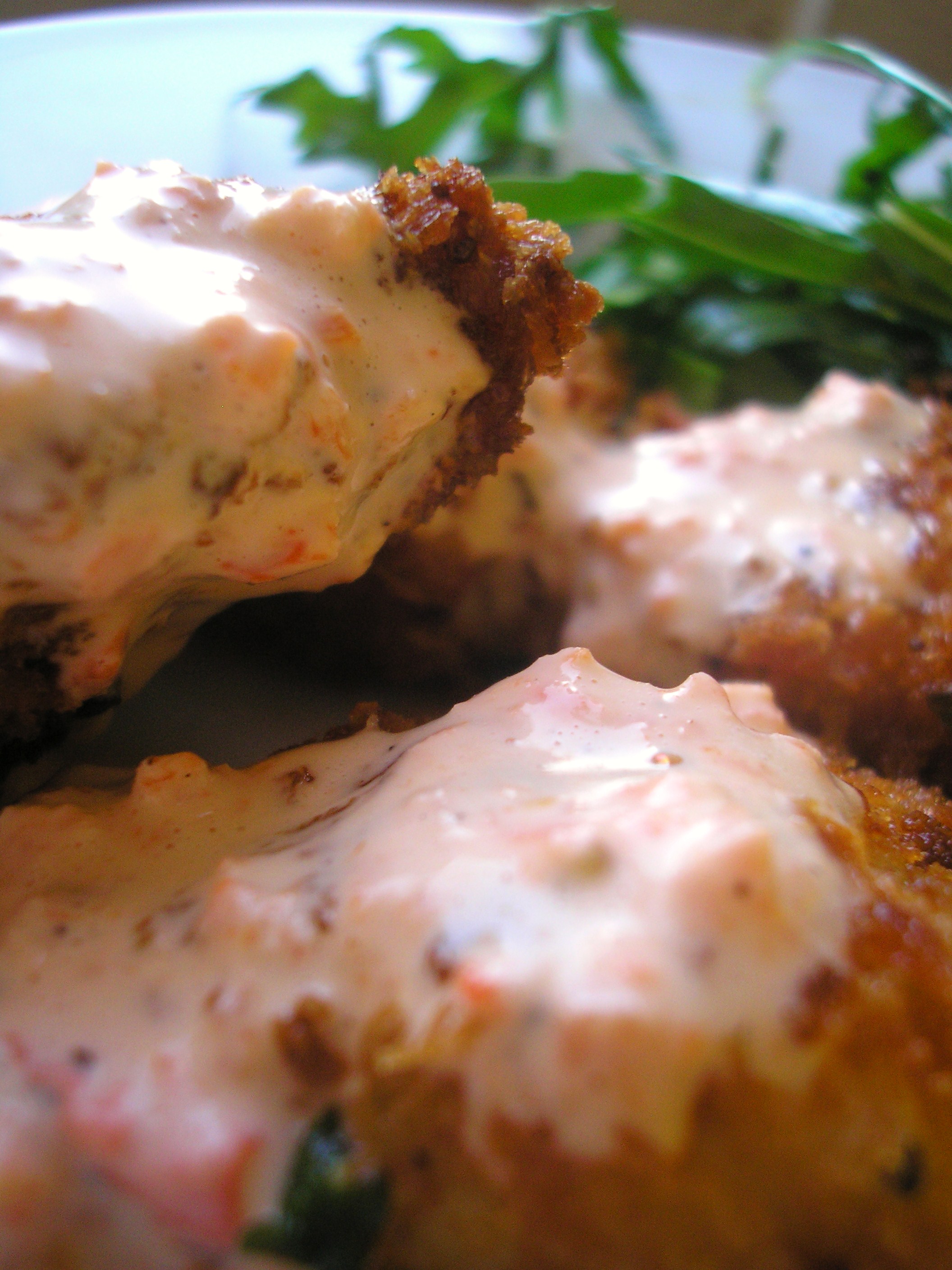
Lambs’ brains do not have a place in my kitchen though I do concede that some people like them.  Instead I like to crumb free range chicken or seafood.  I prefer to use Japanese panko breadcrumbs as they produce a crispier result – they are available in most supermarkets these days or try your local Asian grocer.  Deep frying is apparently healthier that shallow frying as long as you have the oil hot enough to seal the crumbed coating.  This time I made little gremolata crumbed chicken morsels that can be served as a meal or as finger food.  They are good accompanied by grilled capsicum mayonnaise.

Tasty and versatile

Gremolata Crumbed Chicken Morsels  

Ingredients

600g free range chicken breast fillets

2 cups Japanese panko breadcrumbs

2 tbs finely chopped Italian parsley

1 tbs finely grated lemon zest

1 tbs minced garlic

2 free range eggs (lightly beaten with a dash of milk)

1/2 cup plain flour

sea salt and freshly ground black pepper (to taste)

1/2 – 1 grilled capsicum (pureed in the food processor)

1/2 – 1 cup home made or good quality commercial whole egg mayonnaise

Method

Cut chicken into bite sized pieces.  In a large bowl mix together your breadcrumbs, parsley, lemon zest and minced garlic.  Place flour on a plate and season with salt and pepper.  Place your egg wash in a bowl.  Dredge your chicken pieces in flour, dip in the egg wash, then the breadcrumbs.  Make sure they are well coated.  Refrigerate 1 hour to ‘set’ the crumb.  Heat 2 cups sunflower oil in a large saucepan or wok.  The oil is hot enough when bubbles form around the handle of a wooden spoon that is dipped in.  Gently fry the chicken morsels until golden brown all over – I regulate the temperature of the oil by adding or removing the food.  Drain on a wire rack over a tray and finish for 10 mins in a 180c oven.  To make the mayonnaise – mix the grilled capsicum puree with the mayonnaise, season with salt, pepper and a squeeze of lemon juice.

Here’s to the humble onion

In Recipes on November 13, 2011 at 4:29 am

It is hard to imagine how cooks throughout the centuries would have fared had they not had the common onion to flavour their dishes.  Many dishes around the world begin with onion gently fried in oil or butter – these include soups, stews, casseroles and sauces.  European peasants, in particular, would have eaten some very plain food if they had been deprived of onions as a seasoning.  Onions are very versatile and can be pickled, fried, baked, stuffed or caramelised.

Onions have unique health giving properties and are said to contain antioxidants, anti-inflammatories, they can help lower cholesterol and they are said to be useful against osteoporosis, particularly when women are at the highest risk – during menopause.

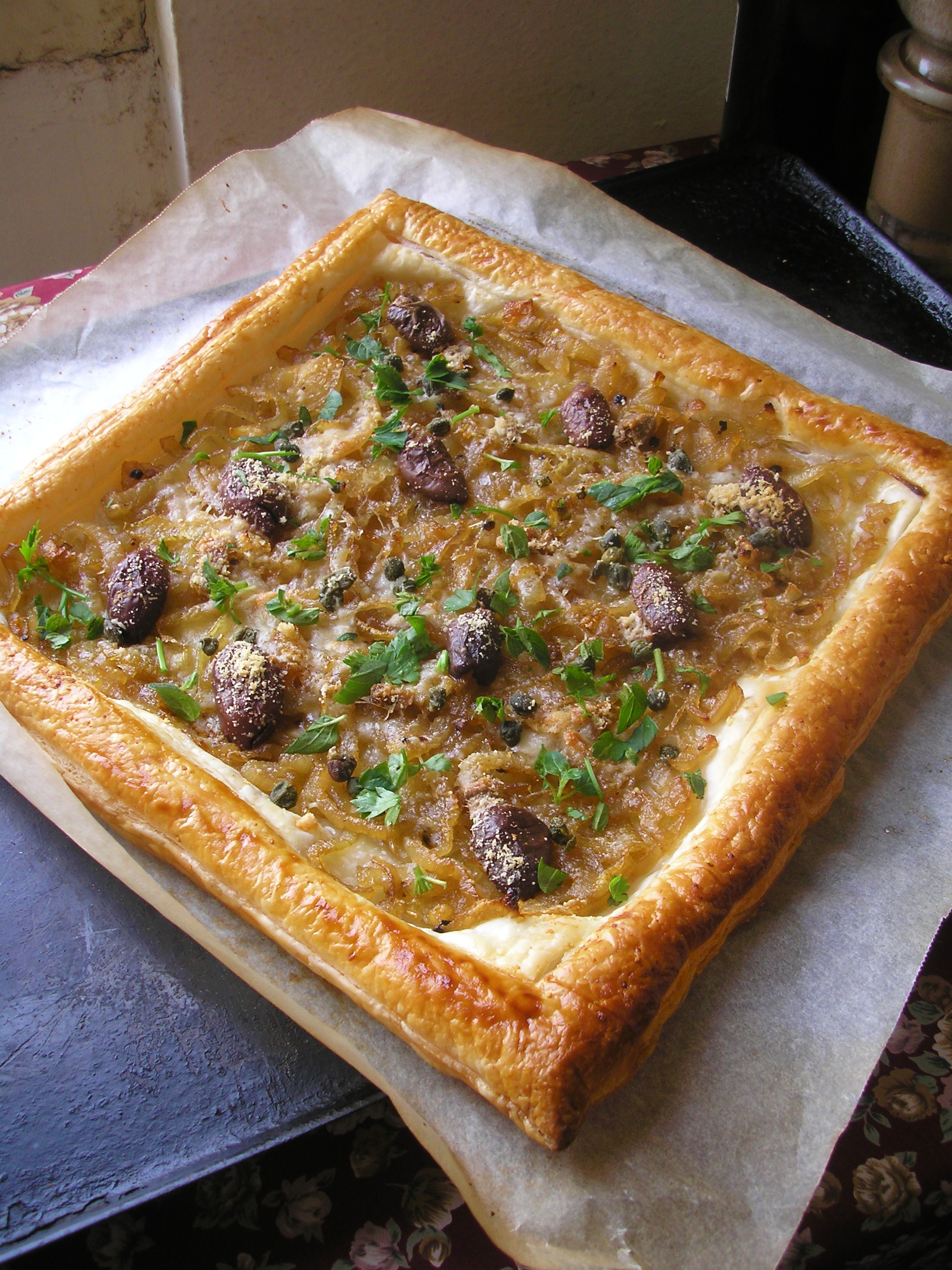
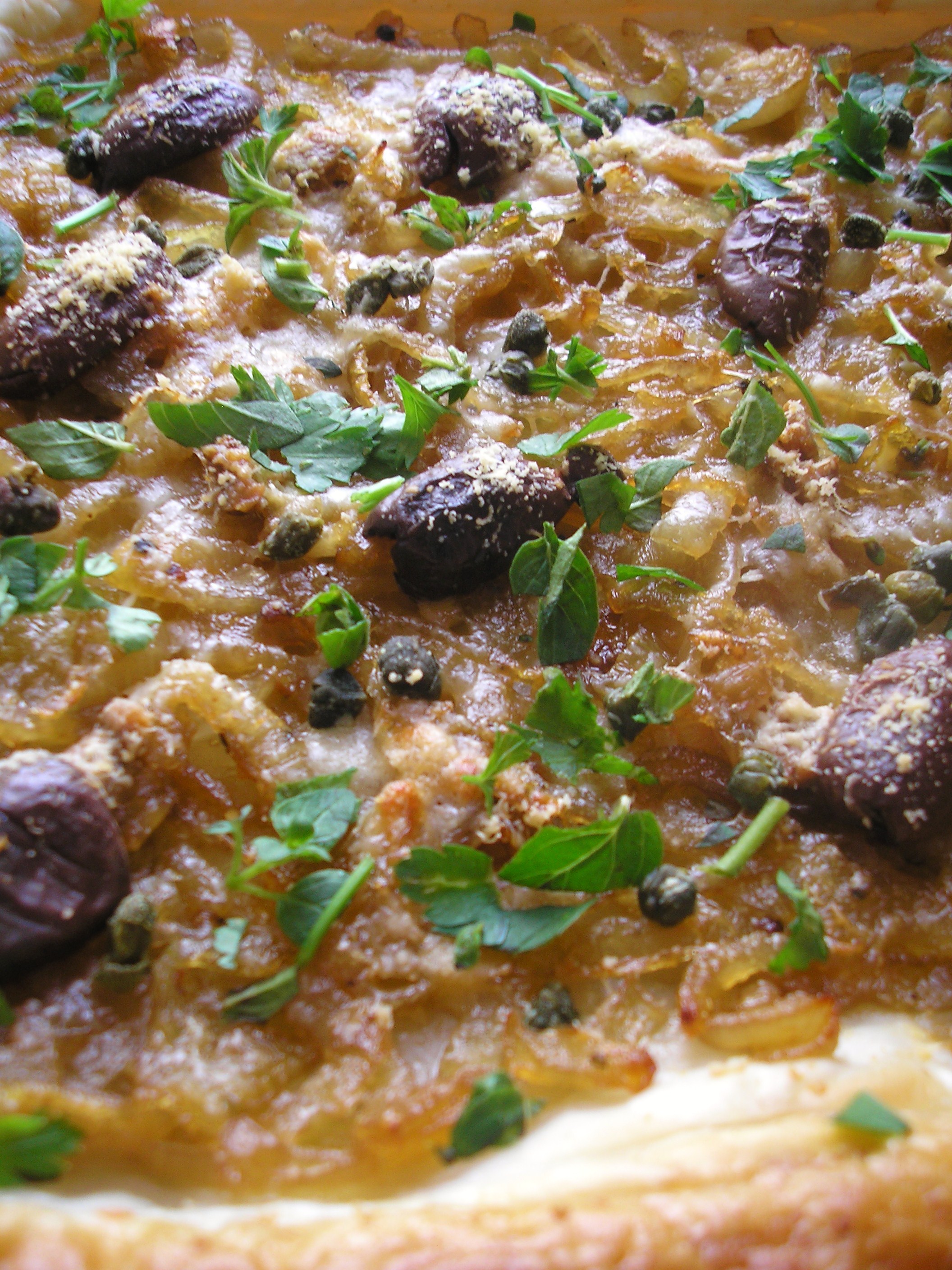
When onions are cooked down slowly in some oil and butter they become sweet.  The addition of a couple of bay leaves, some sugar and a little balsamic vinegar, combined with further cooking down, gives a lovely caremelised result.  These can be used as a base for various tarts and pizzas, or on homemade burgers.  The French classic, pissaladiere, combines a pastry base spread with caramelised onions, topped with a diamond pattern of anchovies, studded with olives and baked.  I make a number of variations on this classic recipe – with less anchovy and sprinkled with freshly grated Parmesan cheese and chopped capers or you can omit the olives and anchovies and top it with crumbled feta instead.  If you have frozen puff pastry sheets available these tarts make a quick lunch or snack and can be made from ingredients to hand.

Onion tart with a touch of anchovy, olives, capers and Parmesan

Onion Tart  

Ingredients

6 large onions (this makes enough for 3 pastry sheets)

1 tbs butter

1 tbs olive oil

2 bay leaves

1 tbs sugar

1 tbs balsamic vinegar

3 frozen puff pastry sheets

beaten egg

an assortment of toppings to be used in your favourite combo – anchovies, capers, feta, Parmesan etc.

Method 

Heat oil and butter in a heavy based pan, add sliced onions and bay leaves.  Fry until translucent.  Reduce heat and add sugar, balsamic and a tbs of water.  Allow the onions to cook gently for 30 mins stirring occasionally and adding a little more water if the onions are sticking.  The finished result should be pale brown.

Thaw pastry sheets and score around the edges.  Spread 1/3 of the cooled onion on each base, inside the scoring.  Top with your chosen toppings.  Brush egg around the edges and bake 15 mins in a pre-heated 220c oven.  Reduce heat to 180c and cook for a further 15-20 mins or until the pastry is golden brown.

A simple lunch option

Keeping it Simple

In Recipes on November 3, 2011 at 3:08 am

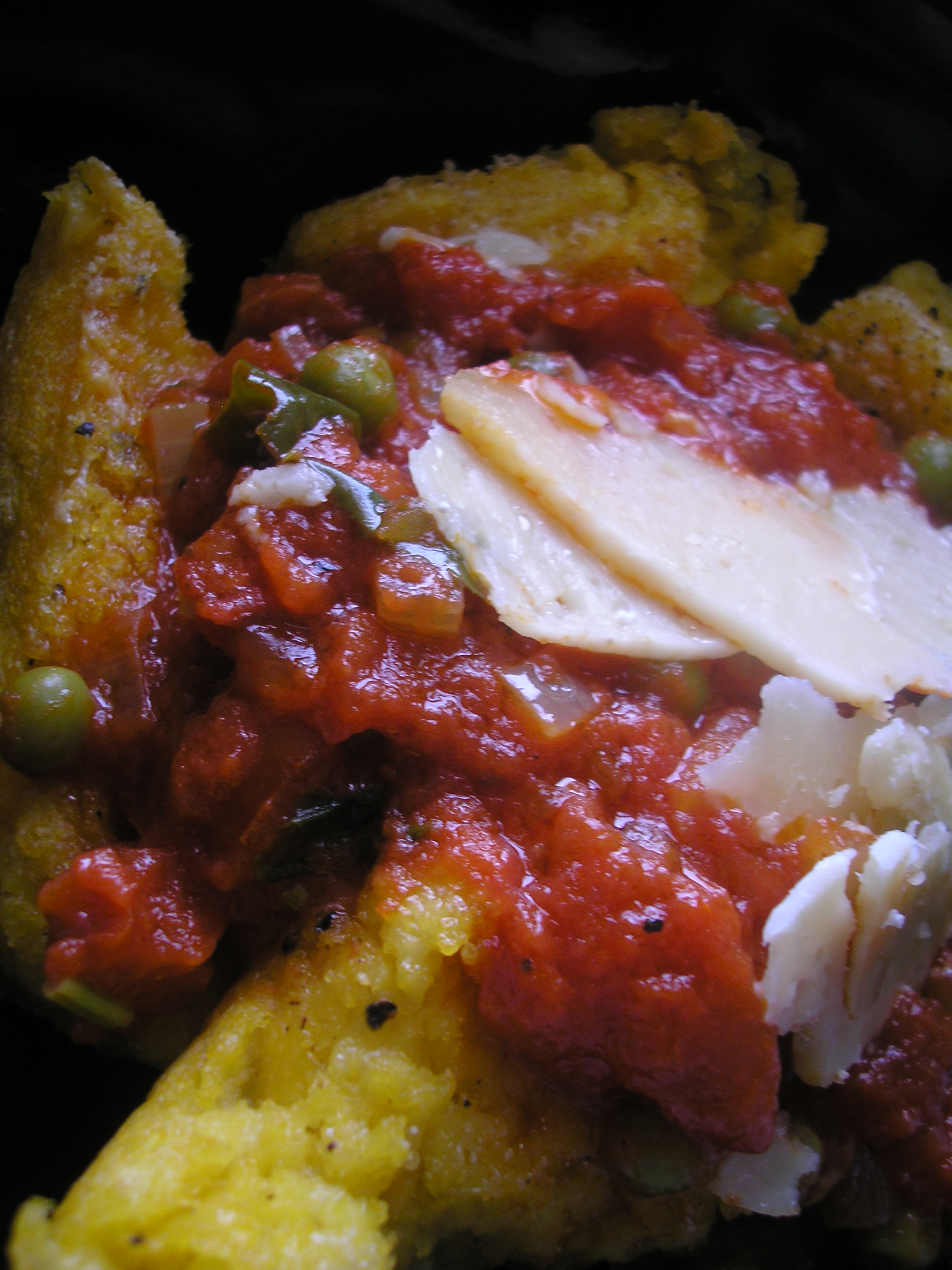
I’ve been reading a number of books about Italian cooking recently.  It seems pasta was and still is a basic foodstuff in most parts of Italy.  That other Italian staple, polenta, was originally only eaten in the northern parts of Italy but it has spread and is now often served as a cheap and delicious alternative to pasta on Italian tables throughout the country.  I like my polenta with lots of cheese, butter and herbs stirred in at the end.  It is even better if poured into a lined baking dish and left to set, then finished with more cheese and baked in the oven.  When serving polenta I prefer to keep the sauce light as the polenta itself is heavy enough. One of the books I have been reading is The Sicilian Kitchen by Brisbane born Michele Di’ Bartolo.  This book is as much a memoir as it is a cookbook.  The Brisbane suburb of West End, where Di’ Bartolo spent much of her time with her Nonna, appears to have been a melting pot of various ethnicities, frozen in time from the moment they left the ‘old country’.  Di’ Bartolo’s Nonna and her parents are Sicilian so this was the culture in which she was raised even though she was Australian born.  Like many cultures, food plays an enormous part in both daily life and special occasions.  By all accounts, life in Sicily was hard – the rocky terrain, the damage wrought by centuries of invasion and conquest, the relative isolation from other parts of Italy, all of these factors played a part.  The average Sicilian was often compelled to stick to a fairly simple diet merely because the options were so limited.  In some cases though, simplicity turns out of be sublime as was the case with the Sarsa Semplice (literally simple sauce) that I made to go with my polenta.

Baked Polenta with Sarsa Semplice

Sarsa Semplice

Ingredients

3 tbs olive oil

1 clove garlic (minced)

1 small onion (finely diced)

4-5 fresh basil leaves

1/4 cup frozen peas

2 x 400g tins of Italian tomatoes

1 tsp paprika (optional)

sea salt and freshly ground black pepper

Method 

Heat the olive oil in a large, heavy based pan.  Add the onion and garlic and fry until translucent.  Add the basil leaves, frozen peas and paprika (if using) and cook for 1 min.  Add the tomatoes, season to taste and simmer over low heat for 30 mins, stirring frequently.  Serve over pasta or polenta.

Baked Polenta

Ingredients

2 cups polenta

boiling water

1 cup Parmesan cheese

100g unsalted butter

3/4 cup chopped fresh basil

sea salt and freshly ground black pepper (to taste)

Method

Cook polenta according to the directions on the packet.  There are two basic types of polenta – the ‘quick’ one takes about 5-10 mins to cook, the traditional one, about 30-40 mins.  It’s your choice but whichever one you are using you need to stir frequently as polenta loves to stick to the bottom of the pot.  When polenta is ready stir in 3/4  of the Parmesan cheese, 1/2 of the butter and the chopped basil, season to taste.  Pour into a lined baking dish and sprinkle the remaining cheese on the top.  Dot with the remaining butter and bake in a 180c oven for 30-35 mins or until the top is lightly brown and the edges a bit crispy.  Serve with your favourite sauce.

Dill or no dill

In Recipes on October 10, 2011 at 1:32 am

Although dill is used all over the world it is quite often associated with Eastern European and Russian cooking.  The famous beetroot soup, borsht, is flavoured with dill as are numerous Russian salads.  In Sweden dill is one of the main flavours used when making the cured salmon dish gravlax.  I would also consider dill to be a vital ingredient in cabbage rolls and in the Greek yoghurt dip tzatziki.

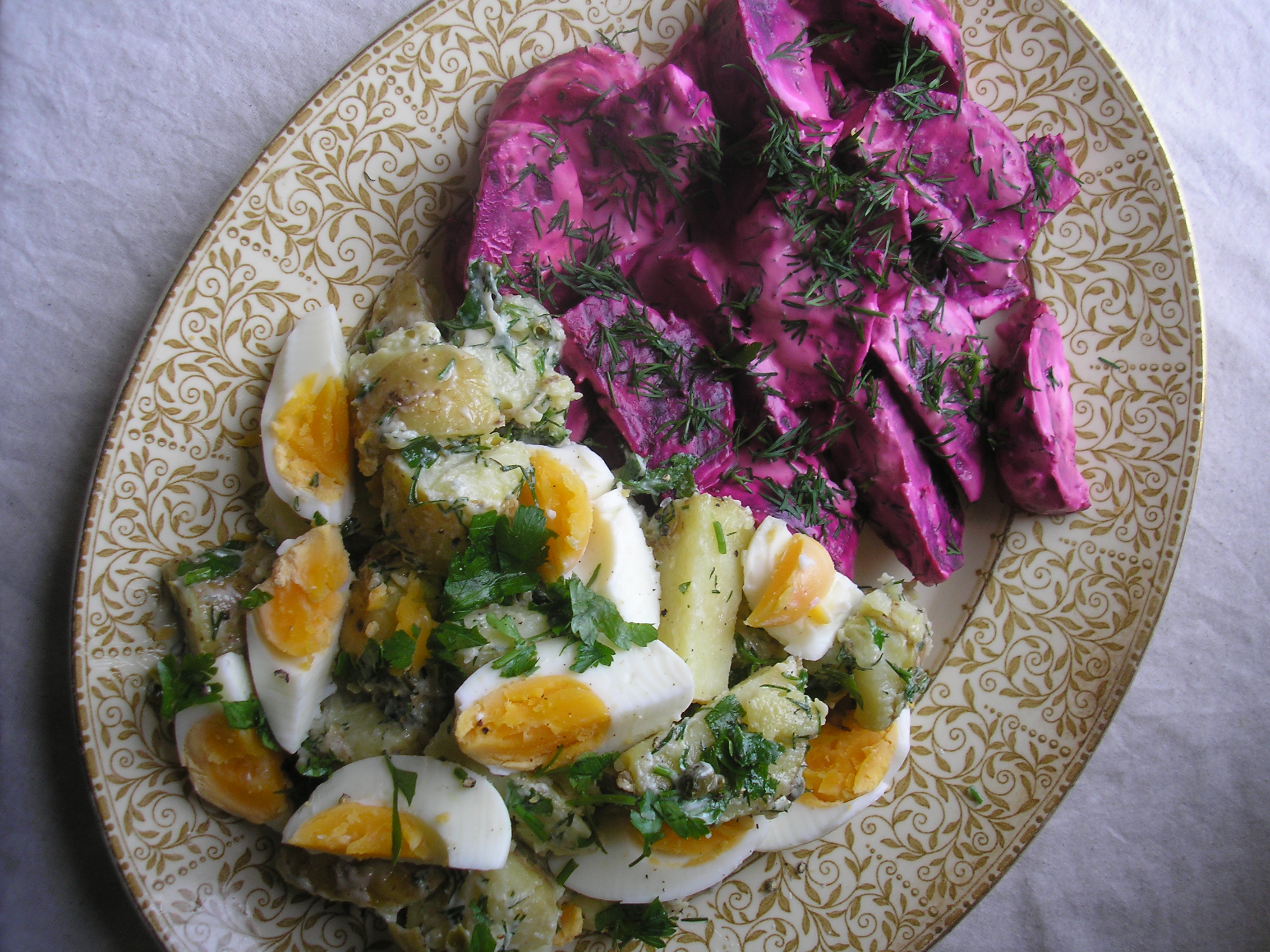
Dill is apparently easy to grow though we have had little success with it in our container garden.  It always seems to ‘bolt’ before it has time to form any useful amount of foliage.  Mum has more success in her country garden but since I haven’t been down there for a while and dill is best fresh I ended up buying some from my local fruit and vegetable supplier who has lovely, lush bunches of fresh herbs for a couple of dollars.  With it I made what I call my borsht salad and a delicious and very filling potato salad made with kipfler potatoes.

Salads

Borsht salad and potato salad

Borscht Salad

Ingredients

3-4 medium sized fresh beetroot

juice of a lemon

1 tbs olive oil

2-3 tbs sour cream

2 tbs chopped fresh dill

1/4 tsp freshly grated nutmeg

sea salt and freshly ground black pepper (to taste)

Method  

Wrap beetroot in foil and bake in a moderate oven for 1 – 1 1/2 hours or until tender when pierced with a skewer.  Allow the beetroot to cool then peel using a pair of tongs to hold the beetroot and a sharp knife.  Cut each beetroot into 8 wedges and place in a large bowl.  Season and dress with the lemon juice and the oil.  Add dill, nutmeg and sour cream.  Toss well.

Kipfler Potato Salad

1kg kipfler potatoes

2 tbs chopped capers

4 hard boiled eggs (sliced into quarters)

2-3 tbs chopped fresh dill

2tbs chopped fresh flat leaved parsley

juice of a lemon

1tbs olive oil

2-3 tbs home made or a good quality bought egg mayonnaise

sea salt and freshly ground black pepper (to taste)

Method  

Fill a pot with cold water and place the scrubbed but not peeled kipfler potatoes in the pot.  Bring to the boil.  Reduce heat and simmer for 15-20 mins or until tender.  Drain and while still warm, slice and place in a large bowl.  Dress with the lemon juice and olive oil, season and allow to cool completely.  Add dill, parsley, capers and mayonnaise.  Toss well.  Arrange the sliced hard boiled eggs on top and sprinkle on some more chopped dill and parsley.

San Choy Now!

In Recipes on October 2, 2011 at 5:27 am

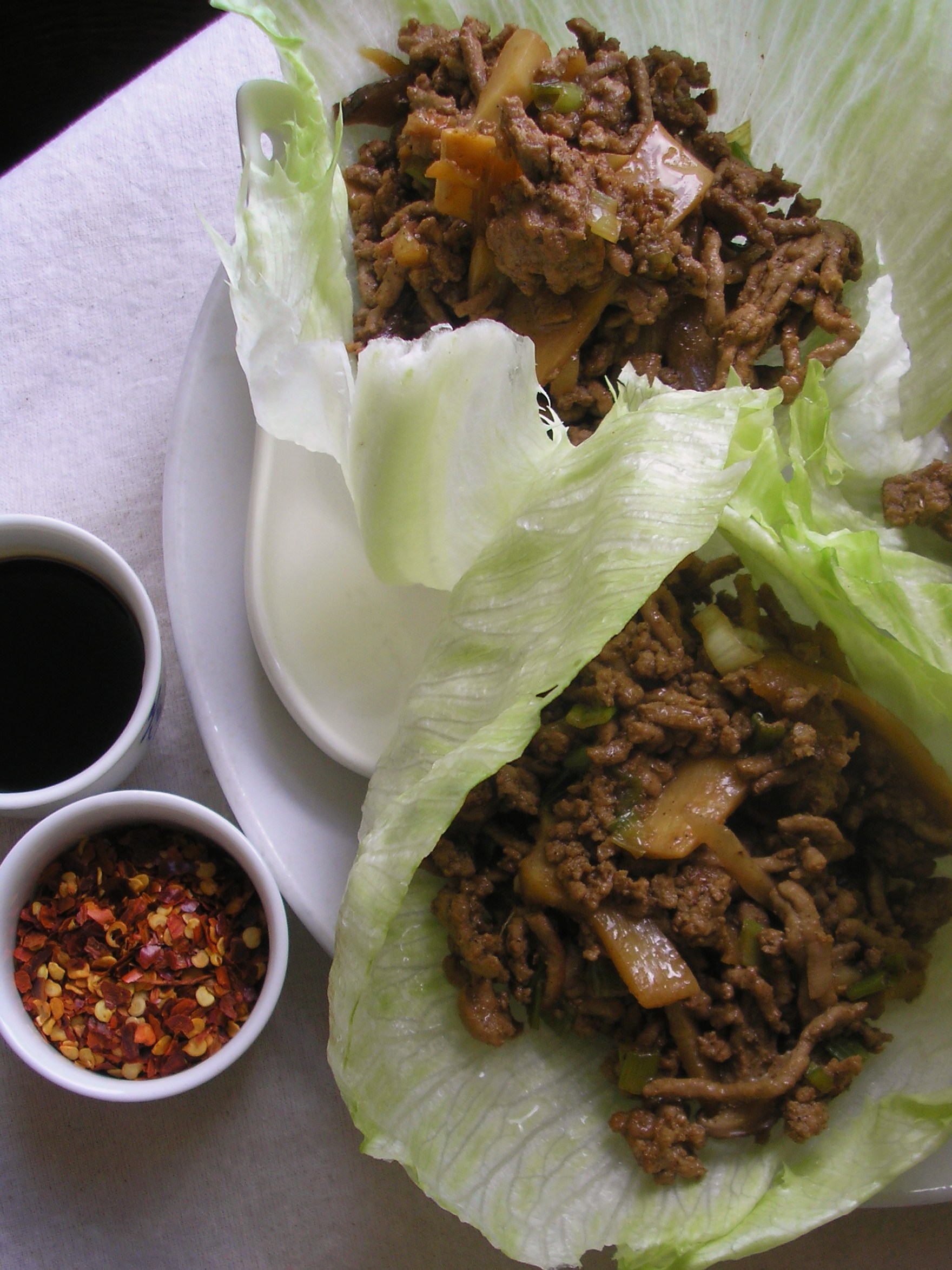
Another good dish for those who want a quick, simple meal is san choy bao.  This minced meat dish has Chinese flavours combined with the textural contrast of crunchy water chestnuts and the iceberg lettuce leaf in which it is served.  It is eaten with the hands – a bit like a healthier Chinese version of the hamburger.

San Choy Bao

Wrap it up in the lettuce leaf and eat it over a plate!

Ingredients  

500g pork mince (or any other mince you have)

2 tbs minced ginger

2 tbs minced garlic

1/2 cup sliced spring onions

10g dried shitake mushrooms (soaked in boiling water according to directions on pack)

40ml Chinese rice wine

40ml dark soy sauce

2tbs light soy sauce

1tbs Chinese black vinegar

1tsp sesame oil

1tsp Chinese five spice

225g tin bamboo shoots

225g tin water chestnuts

2-3tbs peanut oil

Method  

Heat oil in a wok, add mince and fry gently until browned and all moisture has evaporated.  Meanwhile, mix together the soy sauce, rice wine, black vinegar, sesame oil and five spice powder in a bowl.  Add the ginger, garlic, spring onions and mushrooms and fry gently until aromatic.  Add a little of the mushroom soaking water if it is drying out too much.  Add the bamboo shoots and water chestnuts, then the soy sauce mixture.  Reduce for a minute or two.  Serve in iceberg lettuce cups.

Hint

Add a handful of bean shoots on top of the mince for even more textural contrast.