notimeforporridge

Archive for the ‘Recipes’ Category

A (rare) day in the country

In Recipes on May 18, 2012 at 4:14 am

There has been no time for porridge or anything else in my house lately.  The meals I have cooked have been of necessity, simple and quick.  So it was good when I visited the country recently and my parents cooked for me.  I was also able to admire my mother’s neat rows of broad beans, their butternut pumpkin supply and the olives that they have been curing in large plastic buckets in the back room.

olives curing

To cure the olives*  they soak them in plain water for 40 days, changing the water every day.  This helps to remove some of the bitterness.  They then pour over a warm 8% salt solution and leave them, covered,  for 2 days.  The olives are then divided into jars and covered again with an 8% salt solution.  To finish they are covered with an 2-3 mm film of olive oil and must be left for two weeks  before eating.  Mum and Dad keep the jars in the fridge but this may only be necessary after the jars have been opened.  Of course you must use clean, sterile jars to begin with.  The olives can be served marinated in olive oil and lemon juice with a bit of lemon rind, chilli flakes, garlic and herbs.

* for this recipe you must use kalamata olives.
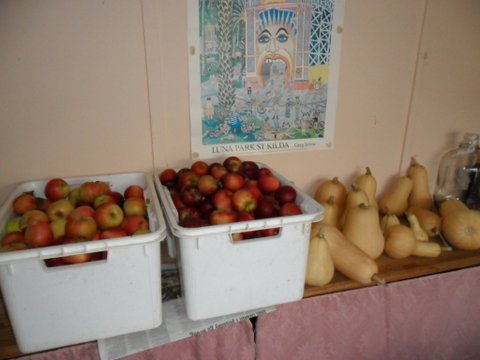
Apples and butternut pumpkins stored for the winter

For lunch we had lamb cooked on the barbecue.  Dad had boned out a leg of lamb – he said this was relatively easy, the main requirement being a really sharp knife.  You could get your butcher to do it for you if you don’t feel up to the challenge.  Dad then made small slits in the meat and pushed in slivers of garlic.  I recommend not using too much as you want the lamb to taste like lamb not garlic.  The lamb was then marinated (for at least an hour) in the juice of 2 lemons, a good slurp of olive oil, chopped sage, thyme and a good few grinds of pepper and sea salt.

Dad then got the barbecue nice and hot and put the lamb on, skin side down.  When seared on that side, he turned it over and did the other side – this took about 15 mins.  He then turned the barbecue down and closed the lid, cooking the meat for about another 30-40 mins.  He then turned the barbecue off and allowed the meat to rest for 15 mins.  The result was beautiful, tender lamb.
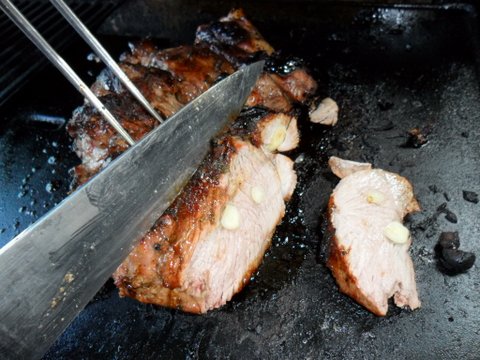
Dad’s delicious lamb

Cheap (er) than chips

In Recipes on April 19, 2012 at 3:44 am

Last week in Brunswick a friend and I were looking for a cheap place to eat.  We didn’t have to go far to find the AI Bakery at 643 – 645 Sydney Road, Brunswick.  This down to earth little place serves up Lebanese pizzas and other dishes, starting at $3.00 each.  You can choose from the tangy meat pizza, the cheese pie (a bit like an Italian calzone) or the cheese and spinach pizza.  Whatever you choose, two people can dine quite well for under $15.00.

For those who don’t live near such a wonderful place as AI, it is pretty easy to make something like them at home.  My version are a bit of a cross between a Lebanese pizza and a Turkish pide.

‘Lebanese’ Pizzas

Delicious lamb pizza

Ingredients 

For the dough:

2 1/2 cups flour

1/2 cup semolina

1 sachet dried yeast

1/2 tsp sea salt

1 1/2 tbs oil

enough warm water to form a dough

For the cheese and spinach topping:

grated haloumi cheese (150-200g makes about 3 or 4)

3 cups washed spinach leaves (finely chopped)

2 tbs finely sliced spring onions

dried mint

chilli flakes

sumac

freshly ground black pepper

For the meat pizza:

500g lamb mince

1 large onion (roughly chopped)

1 tbs fresh mint (finely chopped)

1 tbs fresh coriander (finely chopped

2 tsp sumac

sea salt and freshly ground black pepper (to taste)

chilli flakes and lemon to serve

Method

For the dough:

Mix dry ingredients together in a large bowl.  Add oil, then warm water in 1/2 cup amounts until it forms a firm dough.  Knead in the bowl for a few minutes until smooth.  Oil the bowl and place the dough, covered, in a warm place to rise for 1- 2 hours.

Place the meat, onion, herbs ans spices in a food processor and blitz until a smooth paste is formed.

Portion the dough into four pieces.  Roll out on a floured board until quite thin (about 3 – 4 mm).  Place on an oiled tray.  Pre heat oven to 250c.  For the meat pizza, press meat mixture in a thin layer onto the dough, sprinkle with chilli flakes.  Fold over edges to form an open ‘pie’ (pictured).  Bake in a hot oven for twenty mins. or until the dough is lightly browned.  For the cheese pizza, cover the base with shredded spinach, spring onions and herbs.  Sprinkle generously with haloumi cheese, sprinkle with sumac and chilli flakes.  Bake in a hot oven for twenty mins. or until lightly browned.  Serve with a squeeze of lemon and some yoghurt (if desired).

Cheese and spinach pizza

A taste of Morocco

In Recipes on April 9, 2012 at 2:51 am

Moroccan food is spicy with cumin, coriander and sumac but it is not usually searingly hot with chilli, this makes it a good choice for those who are not fans of hot food.  Another favourite seasoning is preserved lemons – these can be easily and cheaply made yourself if you have a lemon tree or you can buy them.  When using preserved lemons the flesh is discarded and the rind and pith are finely chopped – use them sparingly as they are very strong.  Most Moroccan meals are incomplete without the staple starch cous cous, once made from millet but now made with durum wheat.  This is generally steamed for hours in a special vessel  known in French as a couscoussiere.  The instant cous cous that is widely available in shops has been pre-steamed which means it only takes five minutes to prepare.  This makes it a quick and easy side dish to accompany a meal.

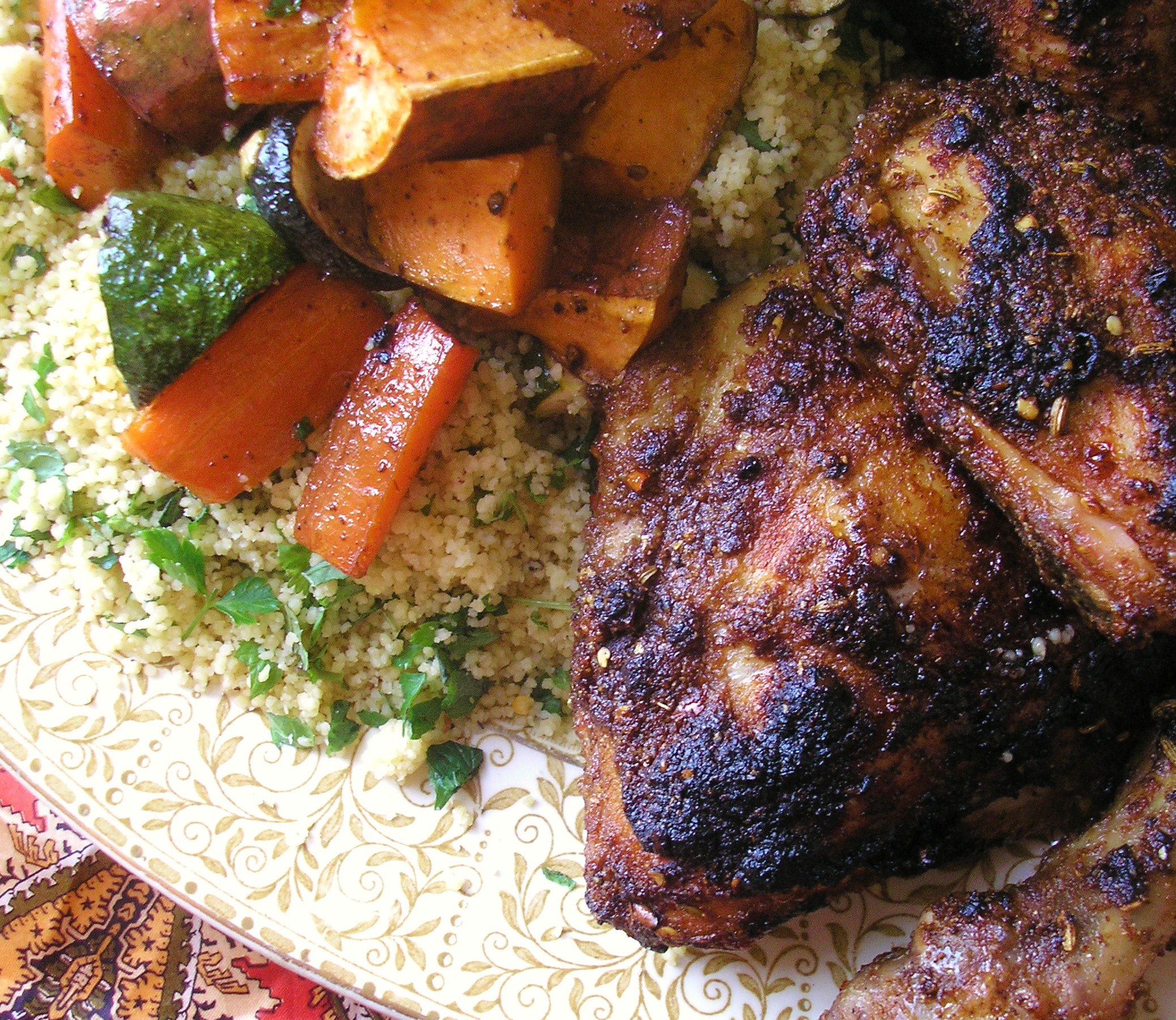
Moroccan chicken with roasted vegetables and cous cous

Moroccan chicken with cous cous

Ingredients

1 free range chicken portioned into eight pieces

For the marinade:

1 tsp fennel seeds

1 1/2 tsp coriander

1 1/2 tsp cumin

1 tsp sumac

1 tsp chilli flakes

1 tsp ras el hanout*

1 tsp dried mint

1/2 tsp freshly ground black pepper

1/2 tsp sea salt

juice of 1 lemon

2 tbs sunflower oil

1 tsp honey

For the vegetables and cous cous:

2 zucchinis (thickly sliced)

1 sweet potato (cubed)

2 carrots (cubed)

2 tbs sunflower oil

1 cup instant cous cous

1 tsp cumin

1 tsp coriander

1 tsp sumac

1 tbs sunflower oil

sea salt and freshly ground black pepper

1 cup boiling water

2tbs chopped fresh mint

2 tbs chopped coriander

2 tbs finely sliced spring onion (green part only)

rind and pith of 1/2 a preserved lemon (finely chopped)

knob of butter

Method

In a large bowl mix all the marinade ingredients together.  Add the chicken pieces and make sure they are all well coated with the mixture.  Refrigerate for at least two hours.  Heat the oven to 220c.  Place the chicken pieces on a rack in a large baking dish, spoon over any remaining marinade.  Roast for 20 mins on the top shelf of the oven.   Meanwhile, toss the vegetables in 2 tbs oil and season well with salt and pepper and tumble into a baking dish.  Move chicken pieces down to second shelf and cook the vegetables on the top shelf for twenty minutes.  Reduce heat to 180c and move the chicken back up to the top shelf, placing the vegetables on the second shelf.  Cook for a further 20-25 mins or until chicken is cooked (the juices run clear) and vegetables are tender.  Mix the cous cous with the dried spices and 1 tbs oil, add boiling water and allow to stand, covered for 5 mins.  Remove cover, add the knob of butter and fluff the cous cous with a fork until all the grains are separate.  Add the fresh herbs, preserved lemon and spring onion.  Serve on a large platter in the middle of the table and allow guests to help themselves.

* see in June The Road to Morocco for ras el hanout recipe

Make it saucy!

In Recipes on March 19, 2012 at 12:30 am

Many people think of eating tofu as a sort of penance.  Yes it’s good for you, low in fat, high in protein – particularly good for women – but it can be very bland.  If you are not vegetarian or vegan you might force yourself to eat some once a month just so you can feel virtuous.  In the end, though, it is tofu’s very blandness that makes it such a wonderful sponge for tasty sauces.  Chinese cooks love tofu, one of their favourite dishes is a combination of pork mince and tofu in a delicious spicy Sichuan sauce called Ma Po Tofu.   Ma (mazi) means someone who is pockmarked so the dish is often translated as ‘pockmarked lady’s face tofu’.  Legend has it that this is because the old widow who first made the dish was disfigured with pockmarks.  I don’t know if this is the case or if the name comes from the appearance of the dish.  Whatever the true explanation it is certainly an interesting name!  Here’s the recipe for the spicy version I made.

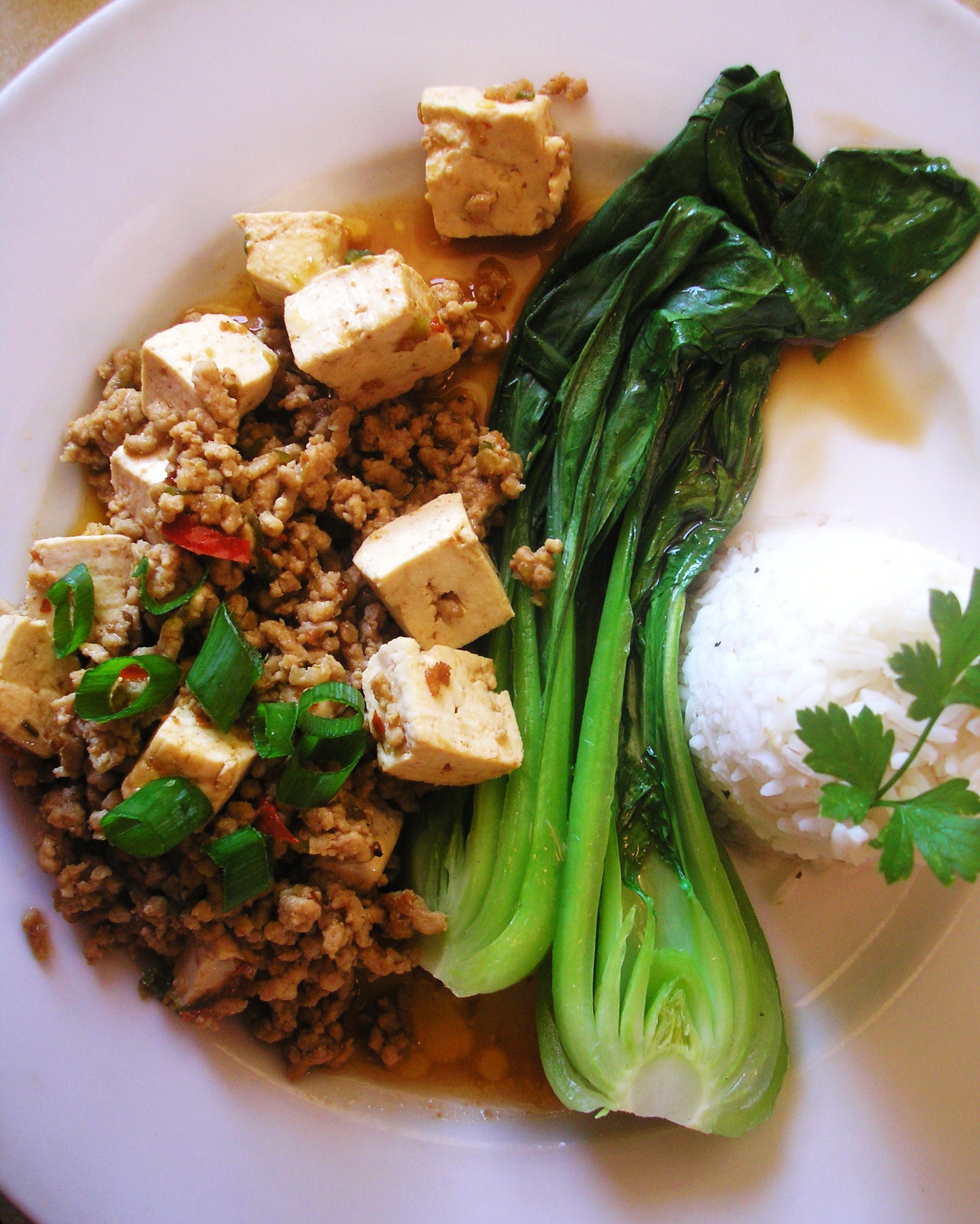
Ma Po Tofu

Ingredients

For the chilli paste:

1 large red chilli

1 birds eye chilli

1 tsp chilli flakes

1 tsp sea salt

1 tsp Sichuan peppercorns

1 tbs vegetable oil (or chilli oil if you like it hot)

Other ingredients:

300g silken tofu

300g fatty pork mince

thumb sized piece of ginger (finely chopped)

2 tbs spicy bean paste (doubanjiang)

2 garlic cloves (minced)

1/4 cup shao hsing wine

2 tsp dark soy sauce

1 tsp brown sugar

1/2 tsp Sichuan pepper and sea salt (ground together)

Method

For the chilli paste:

Finely dice the chillies (leave in the seeds if you like it hot, remove them if you don’t).  Pound to a fine paste with the chilli flakes, Sichuan pepper and salt.  Stir in vegetable oil and set aside.

Other ingredients:

Turn tofu out onto a board and cut into cubes by cutting lengthways into four slices and widthways into five slices.  Heat vegetable oil in a wok until the surface is shimmering.  Add pork mince and stir fry for about 3 mins.  Remove and set aside.  Add chilli paste to the wok with the ginger, garlic, and spicy bean paste – reduce heat and stir fry for 2 mins stirring constantly.  Return the pork to the wok, add wine and stir fry for 1 min.  Add soy sauce and sugar and stir fry for 30 sec – 1 min.  Add water and bring to the boil.  Reduce to a simmer and gently slide in the tofu cubes separating as you go.  Simmer gently with the lid on for 4 mins.  Sprinkle with the salt and Sichuan pepper mixture.  Serve with rice and Asian greens.

Tofu made tasty!

Tofu made tasty!

Hint

Vegetarians could substitute a variety of Asian mushrooms for the pork mince.

I’m potty about herbs

In Recipes on February 26, 2012 at 2:49 am

The herbs in our little container garden are abundant at the moment.  Even the basil has responded to the recent warm weather.  This just goes to show that you can have a productive and tasty herb garden no matter how limited the space available.  I think herbs are the best thing to grow in pots as they add a lot of flavour to dishes when freshly cut and are happy to be in containers.  Vegetables usually require more space and don’t always do well in pots though there are some new varieties on the market.  I have some tiny chillies in a pot that are doing well – a little too well in fact as there are only so many surprisingly hot little red chillies I can use.  I made some chilli oil to use in my Chinese cooking and I might have to hunt around for a Sambal Oelek recipe.

These little babies are hot!

The sage plant my mother gave me appeared to have shuffled off this mortal coil but it has since resurrected itself and looks vigorous and healthy again.  I have been using it in stuffings and terrines and to make the Italian classic Saltimbocca – a piece of veal or chicken beaten out thinly, topped with a sage leaf and prosciutto and fried, prosciutto side down, in a hot pan with butter.

Fry the leaves in some butter and use it to pour over pasta or chicken

The mint has also been growing abundantly and I have been using it to flavour cous cous and tzatziki and to make tabbouleh.  A different way to use mint is to add it finely chopped to cubed watermelon, finely sliced Spanish onion and crumbled feta then dress with lemon juice and olive oil.

Also great in a marinade for strawberries with balsamic vinegar and sugar

Every day is satay day

In Recipes on February 16, 2012 at 5:39 am

Many people buy ready made satay sauce in a jar or a bottle – this is all right but it is really not that hard to make your own and it tastes so much better.  All it takes is the acquisition of a few key ingredients.  Kecap manis, fish sauce, palm sugar, tamarind concentrate – these are the sort of things you would want around anyway if you are cooking Asian food regularly.

The two countries that really love their satay are Malaysia and Indonesia but variations or similar dishes are found throughout South East Asia, China and India.  The satay sauce that I make can be made in larger quantities and frozen, this makes it a super quick and easy meal – all you need to do is cook some rice, grill some meat and heat up the sauce – a quick salad on the side and you have a good meal.

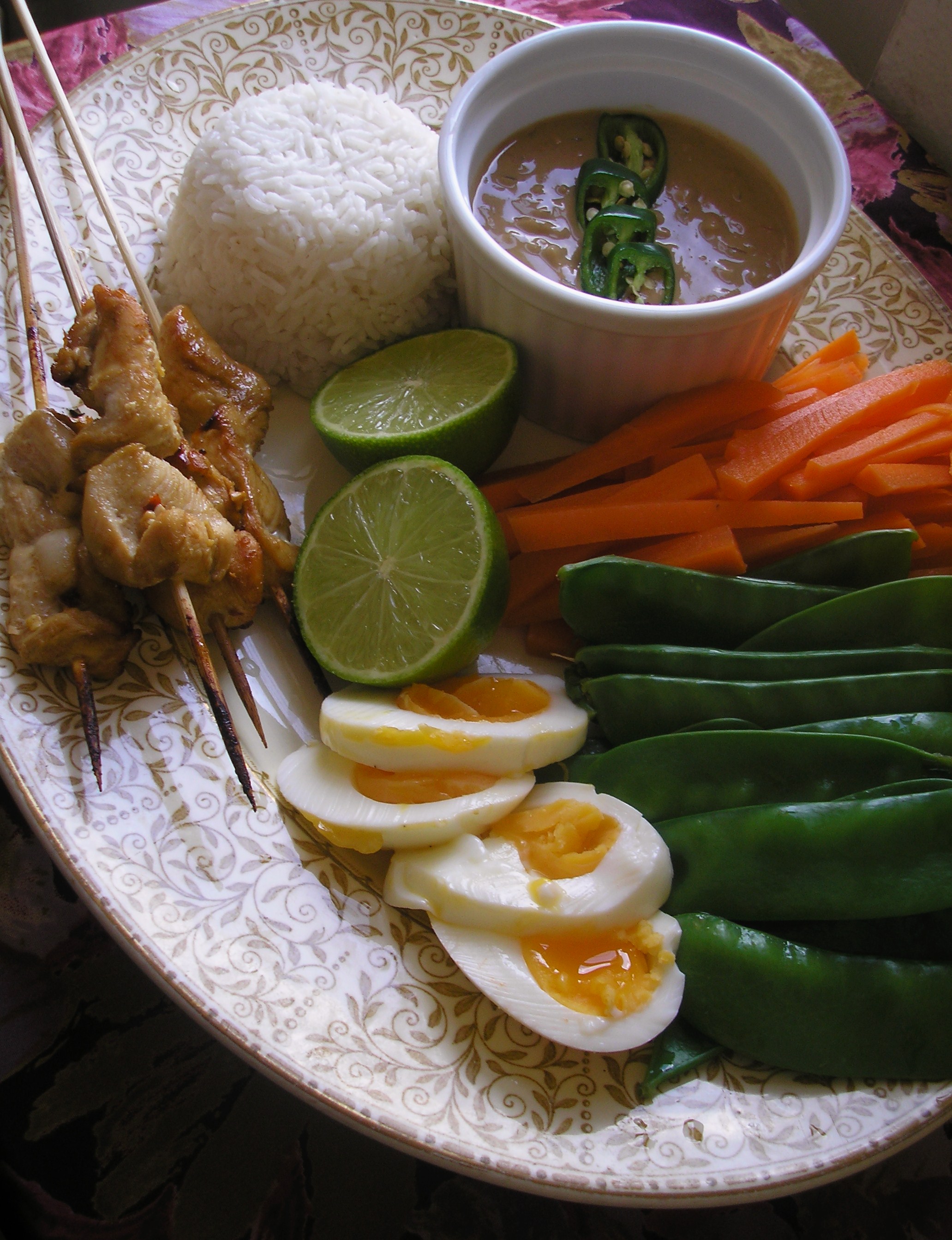
Good served with rice, blanched vegetables and hard boiled eggs

Chicken Skewers with Satay Sauce

Ingredients

For the skewers:

14-16 bamboo skewers (soaked for an hour in cold water)

500g free range chicken breast or thigh fillets (cut in strips)

1 tbs kecap manis

1 tsp chilli flakes

1 tbs grated palm sugar (brown sugar can be used)

1 tsp coriander powder

1 tbs fish sauce

1 tbs peanut or sunflower oil

juice of 1 lime

For the satay sauce:

1 large onion (finely chopped)

2-3 birds eye chillies

1 tsp coriander powder

1 tsp tamarind concentrate

1 tbs kecap manis

1 tbs grated palm sugar (or brown sugar if that’s what you have)

3/4 cup crunchy peanut butter OR 200g roasted unsalted peanuts whizzed in a food processor with 185 ml water

1/2 cup water

1/2 cup coconut milk

1 tbs fish sauce

juice of 1 lime

1-2 tbs fresh chopped coriander

Method

Thread one or two strips of chicken on to each skewer.  Mix all remaining  ingredients in a bowl and pour over skewers, turn to make sure they are well coated in the marinade.  Cover with cling film and refrigerate for 1 hour.  Meanwhile, heat the oil in a heavy based saucepan, when hot add the onions, reduce heat slightly and fry for a couple of minutes.  Add the finely chopped birds eye chillies and fry for a further minute.  Reduce the heat and add the coriander powder, tamarind and peanut butter.  Cook, stirring, for a few minutes.  Add the palm sugar and kecap manis and stir for a further minute.  Add the coconut milk and the water, bring to the boil and reduce over a low heat for 30 mins, stirring occasionally. Finish with the fish sauce, lime juice and fresh coriander.  Set aside.  Grill the chicken skewers until browned and serve with the satay sauce, steamed rice, eggs and blanched vegetables if desired.

A chip off the old (chocolate) block

In Recipes on February 9, 2012 at 3:56 am

When Europeans discovered the so called ‘new world’ they also discovered chocolate.  How the natives felt about these strangers from what they considered an alien new world is anyone’s guess but it seems the secrets of extracting chocolate from cacao beans were generously given to the intruders.  In ancient Mayan culture chocolate was consumed in liquid form from a paste made by fermenting, drying, roasting and winnowing the cacao beans to produce what are known as chocolate ‘nibs’.  These were then ground on a stone and mixed with water and other flavorings to make a drink.  The same process is still used today to make the chocolate nibs needed for chocolate production.

For a couple of centuries chocolate was consumed all over Europe but only in liquid form.  Somewhere along the line sugar was added and the mixture was heated – the Mayans had consumed their chocolate cold and unheated.   It wasn’t until the nineteenth century that the processes needed to make solid chocolate were discovered.  The process used to manufacture cocoa powder from the nibs was discovered by a Dutchman named Van Houten in 1828, this was the first step to making solid chocolate.  Further refinements in the chocolate making process were made by the Fry and Cadbury factories in England in the middle of the century.  Finally, the discovery of a process  to make powdered milk by evaporation  was discovered by Swiss chemist Henri Nestle´ who collaborated with a Swiss chocolate manufacturer to produce the first milk chocolate bar.  These new processes were quickly adopted by the Hershey factory in Pennsylvania and chocolate production on a mass scale began.

One good way to use chocolate is to make the American classic chocolate brownies.  These have become quite popular here in Australia in the last couple of decades and are surprisingly simple to make.  Here’s my recipe.

Easy to make and your friends will love them

Double Chocolate Brownies

Ingredients

250g unsalted butter (cubed)

200g block dark chocolate containing at least 70% cocoa solids (broken into pieces)

1/2 cup flour

1/2 cup cocoa powder

1 tsp baking powder

1 1/4 cups caster sugar

1 tsp vanilla extract

4 free range eggs (lightly beaten)

60g chopped walnuts

1/2 tsp sea salt (optional)

Method

Grease and line a 25cm x 25cm cake tin with baking paper.  In a bowl over a saucepan of gently simmering water melt the butter and the chocolate.  When melted mix well and add the chopped walnuts.  In another bowl, sift the cocoa, flour and baking powder.  Mix through the caster sugar.  Add the melted chocolate mixture to the dry ingredients and mix well.  Add the eggs and combine well until the mixture is smooth and glossy.  Pour into prepared tin and bake in a pre-heated 180c oven for 25-35 mins or until the top is springy to the touch but not too crisp and the middle is not too gooey.  Serve warm with cream or ice cream or cold dusted with cocoa or icing sugar.

Hint

To make Triple Chocolate Brownies add some white or dark chocolate bits to the mixture at the end.  The brownies can also be iced if you wish.

It’s hot, salty, sweet and sour

In Recipes on February 1, 2012 at 1:33 am

Like other South East Asian cuisines Thai food incorporates a balance of flavours.  These are derived from lots of fresh ingredients, a variety of pastes and dipping sauces and the ever present rice and rice noodles.  Fish sauce (nam pla) and shrimp paste are used in many dishes, as are lemongrass, lime juice, palm sugar and chillies.  Other common ingredients are coconut milk, tamarind, coriander, Thai basil and kaffir lime leaves.

These little Thai spring rolls use a variety of Thai ingredients and are surprisingly simple to make.  They are good served with a hot, salty, sweet and sour dipping sauce.

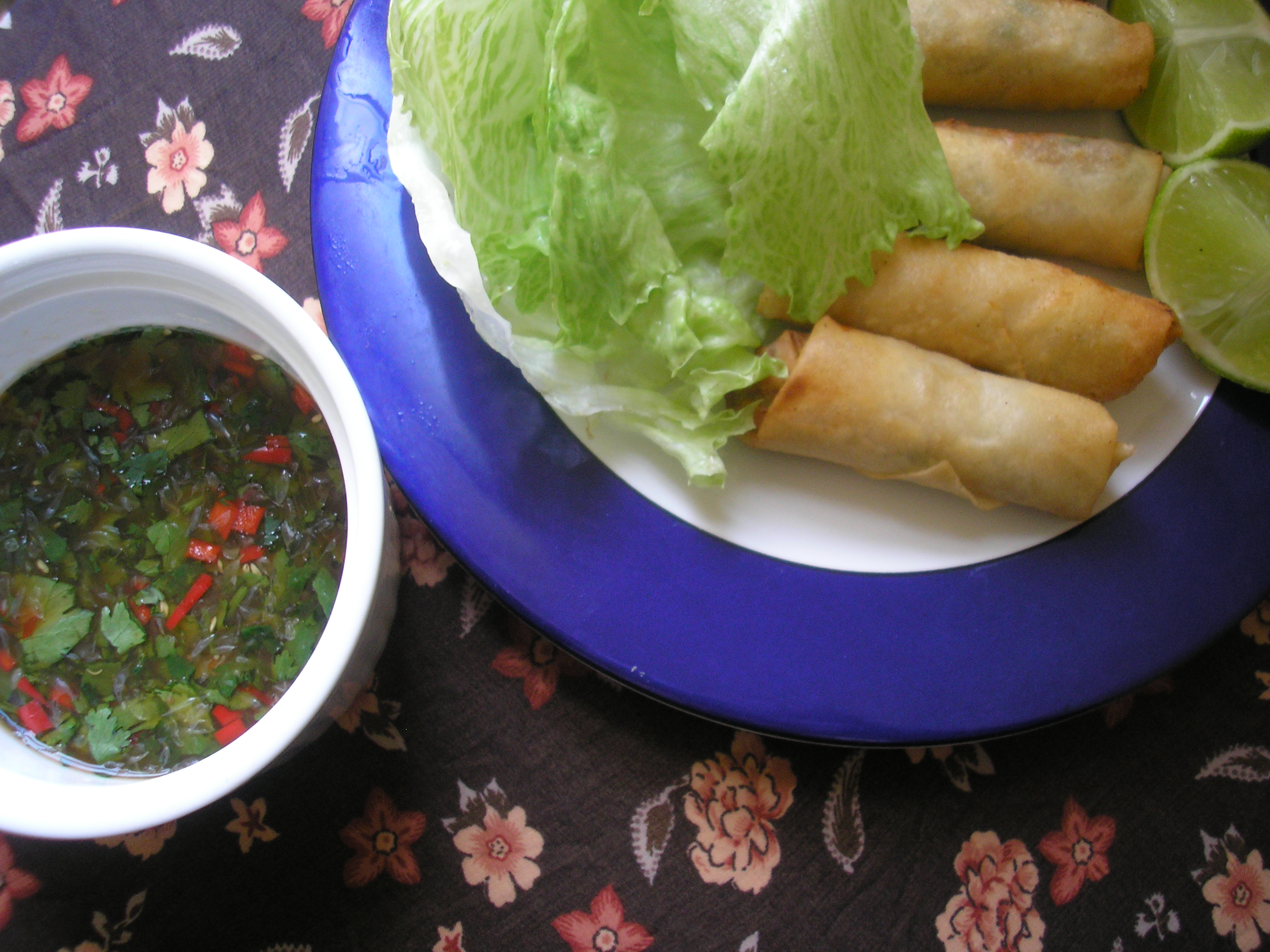
Thai spring rolls with a tangy dipping sauce

Thai Spring Rolls

Ingredients

1 packet small spring roll wrappers (if you can only find the large ones, cut them into four)

500g minced pork (minced chicken or prawn is good too)

2 tbs fish sauce

1 tbs palm sugar (grated)

1 large stalk lemongrass (white part only, finely chopped)

2 cloves garlic (minced)

2 birds eye chillies (finely chopped)

2 spring onions (finely sliced)

1 thumb sized piece galangal (you can use ginger if unavailable)

2 tbs finely chopped coriander (roots, stalks and leaves)

1 tbs finely chopped Thai basil

squeeze of lime juice

For the dipping sauce:

juice of 1-2 limes

2 tbs fish sauce

2 birds eye chillies (seeds and ribs removed, finely chopped)

1 1/2 tbs grated palm sugar (or brown sugar)

1 tbs finely chopped coriander leaves

Method

In a large bowl, mix together all ingredients apart from the spring roll wrappers and the ingredients for the dipping sauce.  I find clean hands are the best for this, you can use gloves if you wish.  Cover and place in the refrigerator for an hour.  Thaw spring roll wrappers and separate the sheets.  You will need a clean board and a cup of water.  Place the spring roll wrapper in a diamond position on the board.  Place a small amount of the meat filling,  moulded into a cylinder shape, near the bottom end of the wrapper making sure to leave a small triangle of pastry.  Fold the small triangle over the meat and tuck in the edges like an envelope.  Wet the rest of the pastry with some water and roll up.  Try to make sure they are well sealed.  Place on a plate, seam side down and continue until all the filling has been used up.

Heat enough sunflower or peanut oil in a wok for deep frying.  You know it is hot enough when bubbles form around the handle of a wooden spoon dipped in the oil.  Fry the spring rolls in batches until lightly golden.  Drain on a wire rack and serve immediately with the dipping sauce.

For the dipping sauce:

Mix together all ingredients, if it is too strong add a little water.  If you are having trouble getting the balance right a tablespoon of sweet chilli sauce is optional.

A delicious finger food option


Life is a picnic

In Recipes on January 25, 2012 at 5:44 am

Fine weather in Melbourne last week made me think of picnics.  My first thought was of the bush or the beach but  not really having the time or the inclination to travel an hour or two to get there my thoughts turned, instead, to our beautiful inner city parks.  Recently my daughter and her friends discovered a lovely old park in Albert Park on St Vincents Place.  With its big old shady trees and green lawns I thought it was the perfect place to host a picnic.

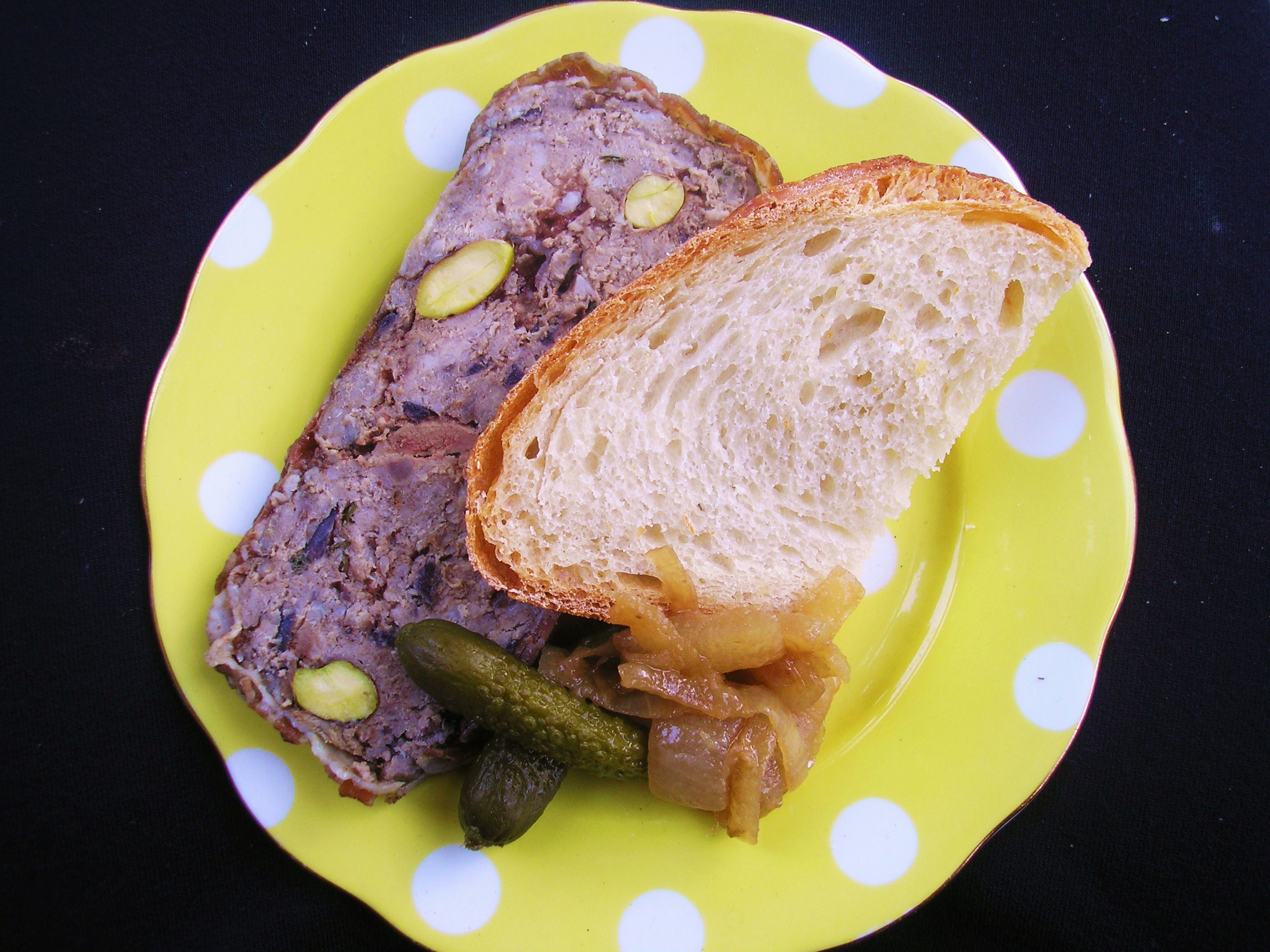
For this picnic I thought I would make a classic picnic dish – pork and pistachio terrine.  This would be supplemented by a couple of caramelised onion and feta tarts, some chicken sandwiches and Stephanie’s English Curd Tart made by my excellent daughter.  Others brought salads, cheesecake and iced tea.  On the day the sunshine was a bit too intense but armed with food, ice, eskies and having found a big old shady tree, we were not too troubled by it.  A relaxing day was had by all.

Pork and Pistachio Terrine

Pork and Pistachio Terrine

Ingredients

600g good quality pork mince (get your butcher to mince it for you from the belly or shoulder)

2oog lean veal mince

250g chicken livers (trimmed and finely chopped)

15 thin slices flat pancetta

1 onion (finely diced)

200ml red wine

2 tbs cognac, brandy or port

1/2 tsp all spice

6 – 8 juniper berries (crushed)

3 – 4 tsp quatre epices*

3 – 4 tbs chopped fresh herbs (sage, thyme, parsley, marjoram, basil etc.)

60g pistachio kernels

sea salt

butter for greasing

1 terrine dish or loaf tin with about a 1kg capacity

Method

Gently fry the onions in a little oil or butter until translucent, add red wine and reduce down until almost all the liquid has disappeared.   Set aside to cool.  Using clean hands, mix the meats, spices, herbs, cognac, onions and pistachios thoroughly.  Cover and refrigerate for  a couple of hours or longer if possible.  Grease your terrine dish or loaf tin, then line with the flat pancetta slices leaving the edges of the slices hanging over the sides to be folded over later.  Remove meat mixture from the refrigerator and gently press the meat mixture into the tin.  Place in a bain marie filled with the water to come halfway up the sides of the terrine dish or loaf tin.  Place in a pre-heated 200c oven for 20 mins.  Cover with foil and reduce heat to 170c and cook for a further 45 mins to an hour or until the juices run clear when pierced with a skewer.  Remove terrine from oven and bain marie, carefully pour off any fat or juices that have accumulated and let cool slightly.  Cover with baking paper, place a piece of cardboard on top and weight with three 400g cans from your cupboard.  Refrigerate overnight.  Turn terrine out onto a plate and serve with crusty bread and cornichons – a relish would be good too.

Stephanie’s English Curd Tart

A hazard of picnics and barbeques alike, the vital implement forgotten!  Naturally we forgot the cake slide so we could get the pieces out but  ‘necessity being the mother of invention’ we managed by sliding a large knife underneath each piece.

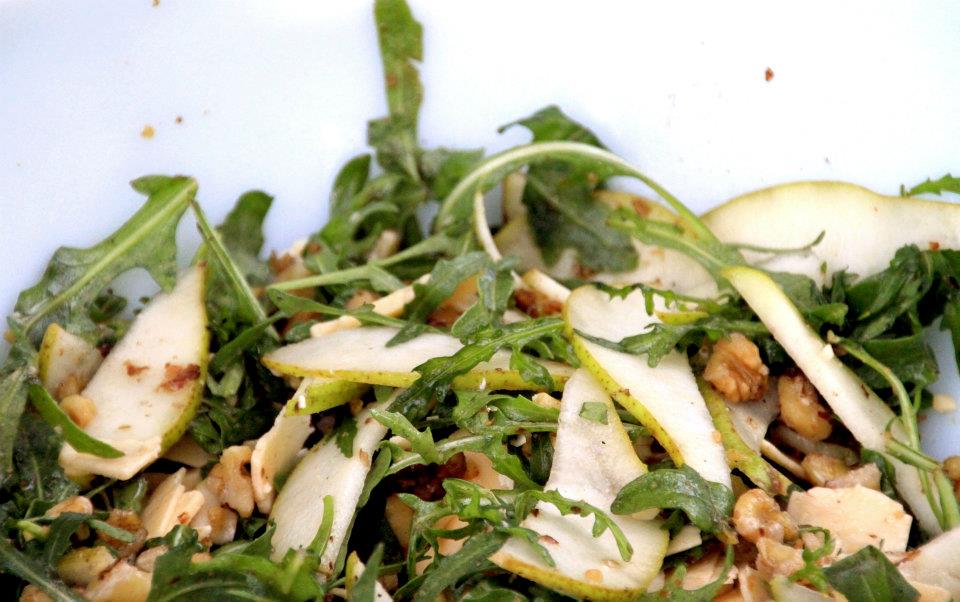
Pear, Parmesan and Rocket Salad

I usually use balsamic vinegar in the dressing but this one had red wine vinegar and it was just as good and didn’t discolour the pears as much.


A delicious and seriously naughty cheesecake

This cheesecake was incredibly sweet and rich.  Everything a cheesecake should be in fact.

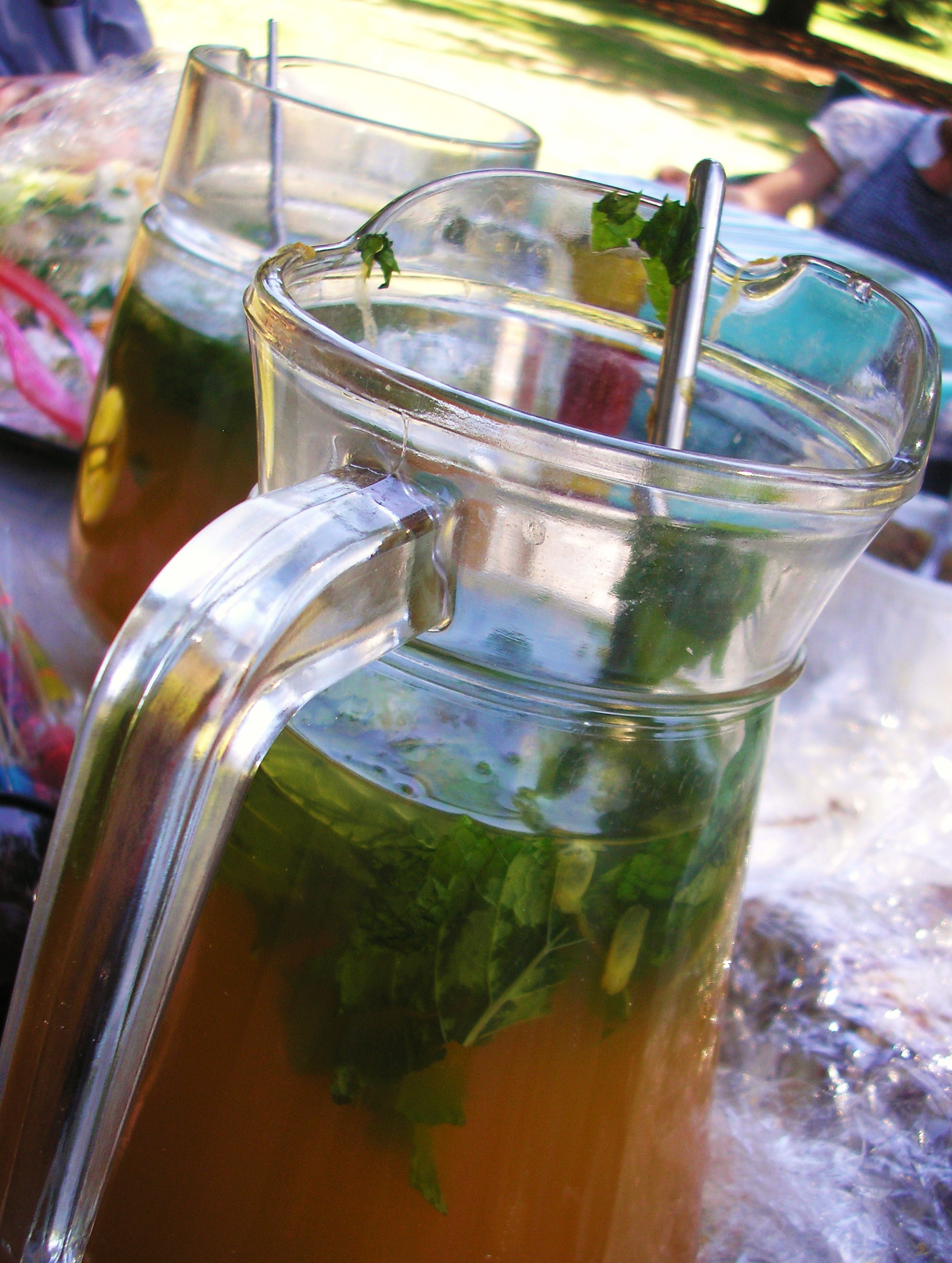
Refreshing iced tea

A brilliant idea on a hot day.  Something adult, tasty and non-alcoholic.  I loved the addition of lychees.

* quatre epices (four spices)

2 tsp white peppercorns (crushed)

1 tsp grated nutmeg

1 tsp ground cloves

1 tsp ground ginger

Mix together

Roll up for norimaki!

In Recipes on January 16, 2012 at 3:17 am

Japanese restaurants were once few and far between in Melbourne.  Now there is a sushi bar on every corner and nori rolls or norimaki are a common alternative to the sandwich as a lunch option.  Availability does not, however, guarantee quality.  Freshness is very important when making norimaki.  This is not only for reasons of taste but also to ensure food safety.  So, how do you avoid a nasty case of food poisoning when buying your norimaki?  Firstly, choose a food outlet that sells Japanese food exclusively, this should (hopefully) mean that they know what they are doing.  Secondly, choose a place that has a high turnover – you can usually do this by observing how many customers are there at peak times. If the place is always crowded then you know the turnover will be fairly high and therefore your norimaki should be fresh.

Another way to make sure your norimaki are fresh is to make your own at home.  They are not difficult and the fillings are only limited by your imagination, although I would advise sticking to Japanese ingedients.  If using fresh fish make sure it is so fresh that it is virtually still swimming and that the rolls are eaten pretty much immediately.  Other fillings you can use are tuna mayonnaise, avocado, teriyaki chicken, cucumber and carrot strips.  If using prawns make sure you cook them first.  This time, because I couldn’t find any fish that was fresh enough I just made avocado rolls and tuna mayonnaise rolls.

Norimaki or nori rolls

Ingredients

2 cups sushi rice

3 cups water

5 tbs Japanese rice wine vinegar

1 tbs mirin (optional)

2 tbs sugar

1/2 tsp salt

nori sheets

4 tbs Japanese or whole egg mayonnaise

185g  tin good quality tuna

2 spring onions (just the green party finely sliced)

1 ripe avocado (cut into thick strips, squeeze a little lemon juice over them to prevent them going brown)

1 continental cucumber and 1 carrot (both cut into thin strips)

wasabi paste

pickled ginger

Method

Rinse the rice once and place in a heavy based saucepan that has a well fitting lid.  Add 3 cups of water, cover and bring to the boil.  Reduce to a low simmer and cook covered for approx. 20 mins or until all the water has been absorbed.  Turn off heat, fluff with a fork and allow to stand for 10 mins.  Turn into a wooden or glass bowl, add rice wine vinegar, mirin, sugar and salt.  Gently fold these flavours through with a wooden or rubber spatula, mix well but try to avoid breaking the rice up too much.  When cooled to room temperature it is ready to use – if not using straight away cover with cling film and store in the refrigerator.  Try to use the rice on the day you made it.

To make the tuna mayonnaise mix the drained tuna with 2 tbs of the mayonnaise an the sliced spring onions.  To make wasbabi mayonnaise mix 1-2 tsp wasabi paste with 2 tbs mayonnaise.

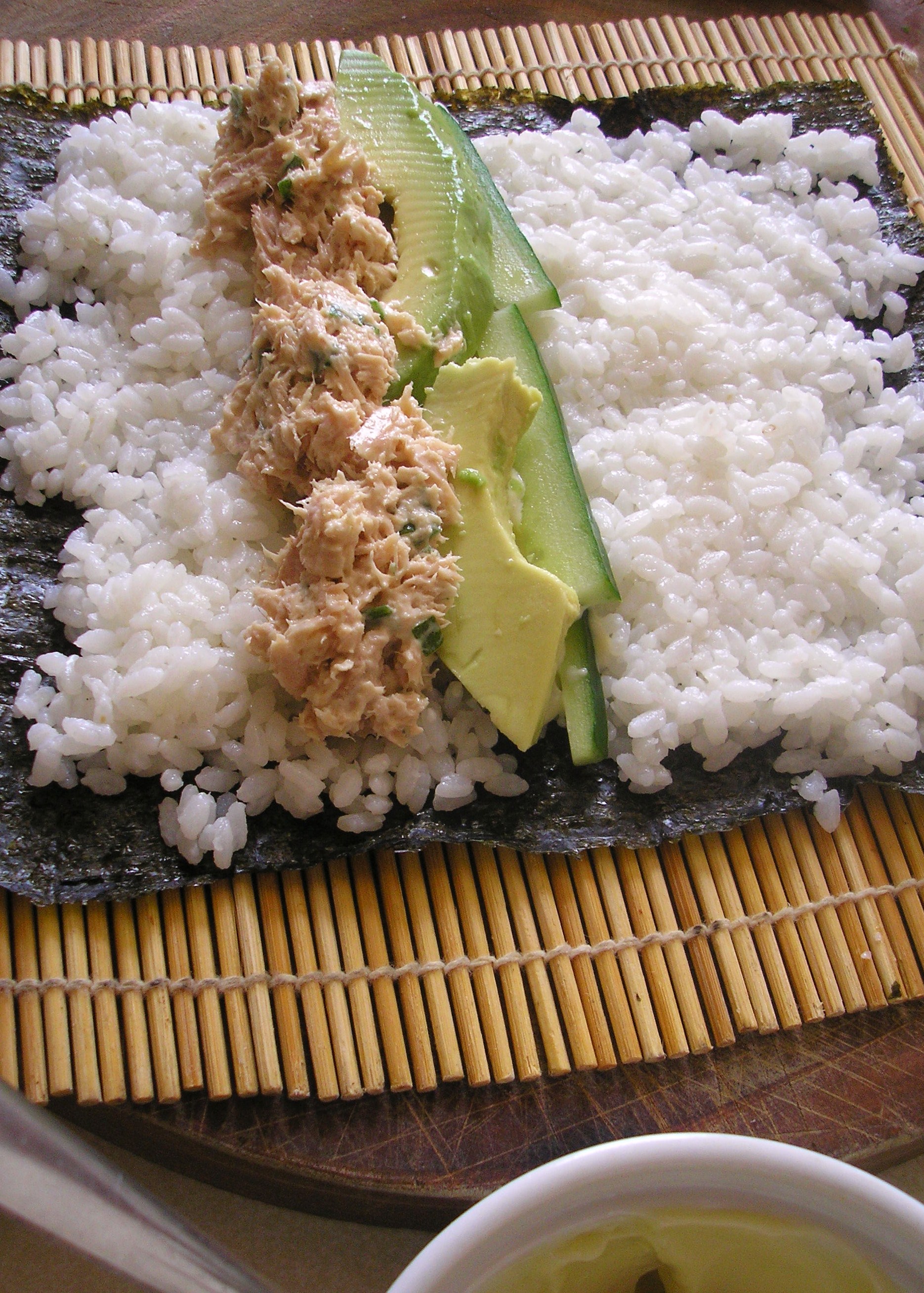
To make your rolls you will need a bamboo sushi mat, a bowl of water your nori sheets, rice and filling.  Over a low gas flame gently pass your nori sheet over the jet once or twice, do not burn.  Place the sheet shiny side down on your bamboo mat.  Wet your hands and gently press a layer of rice onto the nori sheet leaving a 1cm edge on the part furthest from you.  Place chosen filling down the middle of the rice.

Place chosen ingredients down the middle of the rice

Gently begin to roll, tucking the filling in as you go, use the bamboo mat to help you.  Wet the 1cm edge of the nori and continue to roll until it has come together.  Apply gentle pressure with your hands around the bamboo mat until your roll is well melded – don’t press too hard or you will squeeze the filling out.

Your roll should look like this

To cut into even pieces cut in half, then quarters, then eighths.  Arrange on a plate and serve with soy sauce, wasabi and pickled ginger.

The finished norimaki